
Digitalis purpurea subsp. heywoodii 'Silver Fox'
Also known as: Information to be completed
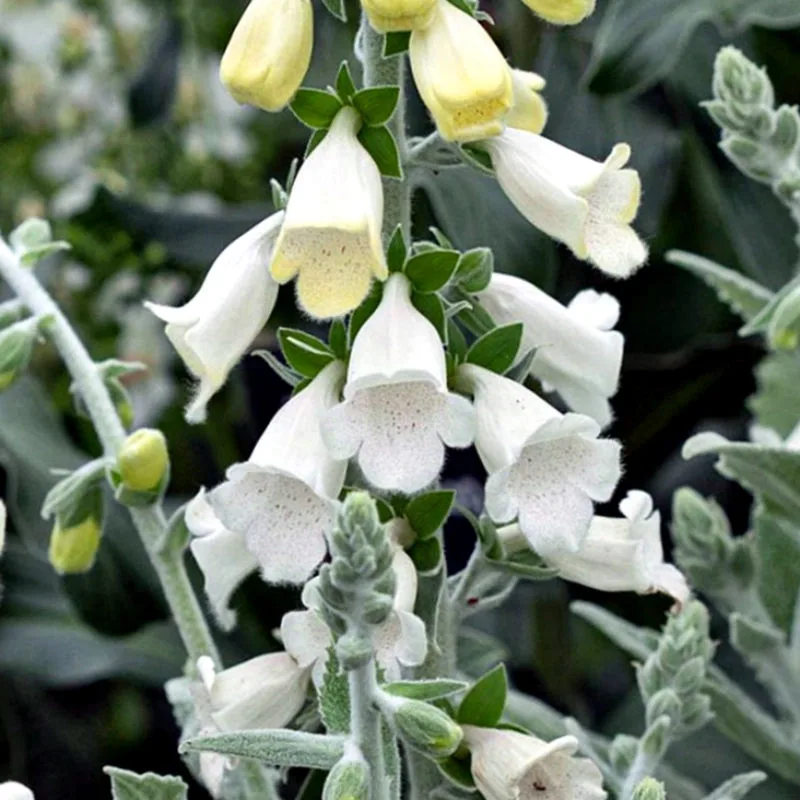
Silver Fox' is a biennial or short-lived perennial forming a rosette of lance-shaped, downy, silvery, greyish-green leaves. Upright flowers spikes to around 70cm tall arise from the basal rosette in summer with creamy-white flowers flushed with pink and lightly-speckled throats
Scientific classification
- Species
- Digitalis purpurea subsp. heywoodii 'Silver Fox' (Digitalis purpurea subsp. heywoodii 'Silver Fox')
- Genus
- Digitalis
- Family
- Plantaginaceae
- Order
- Lamiales
- Class
- Magnoliopsida
- Phylum
- Magnoliophyta
- TOXIC if eaten. Wear gloves and other protective equipment when handling
- Toxicity
- Annual Biennial
- Plant type
- 0.5-1 metres
- Height
- 0.1-0.5 metres
- Spread
- Semi evergreen
- Foliage
- Columnar upright
- Habit
- Spring · Summer · Autumn
- Season of interest
- Full sun · Partial shade
- Sunlight
- Information to be completed
- Ideal temperature









Digitalis purpurea subsp. heywoodii 'Silver Fox' pictures
Distribution of Digitalis purpurea subsp. heywoodii 'Silver Fox'
Distribution map
- Native
- Introduced
- Cultivated
Source:WCVP v16 · Royal Botanic Gardens, Kew · CC BY 3.0 · Boundaries:WGSRPD / TDWG
Toxicity
TOXIC if eaten. Wear gloves and other protective equipment when handling
Digitalis purpurea subsp. heywoodii 'Silver Fox' care guide
- Water regularly to keep the soil evenly moist, but avoid waterlogging.
- Watering
- Full sun · Partial shade
- Sunlight

Watering
Water regularly to keep the soil evenly moist, but avoid waterlogging.
Fertilizing
 Fertilizing
Apply a balanced liquid fertilizer every 3-4 weeks during the growing season.
Pruning
 Pruning
Deadhead after flowering unless seed is required
Propagation
 Propagation
Propagate by seed
Growing
 Growing
Grow in almost any soil, but avoid very wet or very dry positions. Prefers a humus-rich soil in partial shade but will grow in full sun
Common pests and diseases
Diseases
May be susceptible to powdery mildews, downy mildews and leaf spot
Pests
May be susceptible to aphids and leaf and bud eelworm
Explore the plant health library →




