
Astrantia major subsp. involucrata 'Jumble Hole'
Also known as: Information to be completed
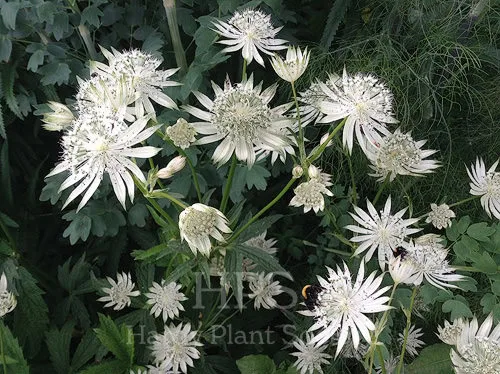
An upright, clump-forming herbaceous perennial with deeply divided mid-green leaves and branched stems bearing compact heads of small white flowers surrounded by green-tipped white bracts in summer
Scientific classification
- Species
- Astrantia major subsp. involucrata 'Jumble Hole' (Astrantia major subsp. involucrata 'Jumble Hole')
- Genus
- Astrantia
- Family
- Apiaceae
- Order
- Apiales
- Class
- Magnoliopsida
- Phylum
- Magnoliophyta
- Information to be completed
- Toxicity
- Herbaceous Perennial
- Plant type
- 0.5-1 metres
- Height
- 0.5-1 metres
- Spread
- Deciduous
- Foliage
- Clump forming
- Habit
- Spring · Summer
- Season of interest
- Full sun · Partial shade
- Sunlight
- Information to be completed
- Ideal temperature









Astrantia major subsp. involucrata 'Jumble Hole' pictures
Distribution of Astrantia major subsp. involucrata 'Jumble Hole'
Distribution map
- Native
- Introduced
- Cultivated
Source:WCVP v16 · Royal Botanic Gardens, Kew · CC BY 3.0 · Boundaries:WGSRPD / TDWG
Astrantia major subsp. involucrata 'Jumble Hole' care guide
- Even moist soil growth phase, avoid full drying root ball out
- Watering
- Full sun · Partial shade
- Sunlight

Watering
Even moist soil growth phase, avoid full drying root ball out
Fertilizing
 Fertilizing
Astrantia balanced feed every three weeks spring through autumn
Pruning
 Pruning
Deadhead before seed is ripe to prevent self-seeding
Propagation
 Propagation
Propagate by seed sown in pots in a cold frame as soon as seed is ripe or propagate by division in spring
Growing
 Growing
Best grown in moist, fertile, humus-rich soil in sun or partial shade but will tolerate drier conditions
Common pests and diseases
Diseases
May be susceptible to powdery mildews
Pests
May be susceptible to astrantia leaf miner
Explore the plant health library →




