
White Stonecrop
Also known as: White Stonecrop, Coral Carpet Stonecrop
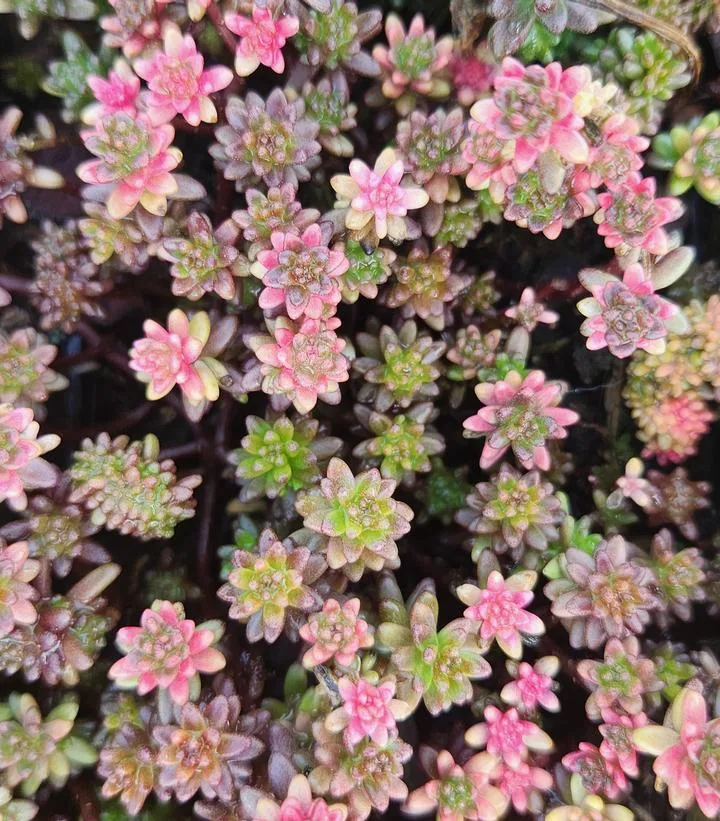
Sedum album 'Coral Carpet' is a low-growing, mat-forming succulent perennial with tiny, fleshy, cylindrical leaves that turn coral-red in full sun. In summer, it produces clusters of star-shaped white flowers. This vigorous ground cover spreads quickly, forming dense cushions ideal for rockeries, dry banks, and containers.
Scientific classification
- Species
- White Stonecrop (Sedum album 'Coral Carpet' or Sedum stahlii variegata)
- Genus
- Sedum
- Family
- Crassulaceae
- Order
- Saxifragales
- Class
- Magnoliopsida
- Phylum
- Magnoliophyta
- Non-toxic to humans and pets.
- Toxicity
- Cactus Succulent · Alpine Rockery · Herbaceous Perennial
- Plant type
- 0.05 - 0.1 metres
- Height
- 0.3 - 0.5 metres
- Spread
- Evergreen
- Foliage
- Matforming · Spreading
- Habit
- Summer
- Season of interest
- Full sun
- Sunlight
- Information to be completed
- Ideal temperature









White Stonecrop pictures
Distribution of White Stonecrop
Distribution map
- Native
- Introduced
- Cultivated
Source:WCVP v16 · Royal Botanic Gardens, Kew · CC BY 3.0 · Boundaries:WGSRPD / TDWG
Toxicity
Non-toxic to humans and pets.
White Stonecrop care guide
- Water sparingly, let soil dry completely between waterings
- Watering
- Full sun
- Sunlight

Watering
Water sparingly, let soil dry completely between waterings
Fertilizing
 Fertilizing
Fertilize once in spring with diluted formula
Pruning
 Pruning
After flowering, trim back spent flower stems to maintain a tidy appearance. Remove any dead or faded foliage in early spring before new growth begins.
Propagation
 Propagation
Easily propagated by stem cuttings or division in spring or early summer. Take 5–8 cm stem cuttings, remove lower leaves, and insert into gritty, well-drained compost. Rooting occurs within 2–3 weeks at 15–20°C. Division can be done by lifting clumps and replanting small rosettes.
Growing
 Growing
Grow in well-drained, sandy or loamy soil in full sun. Tolerates poor, shallow soils and is highly drought-tolerant once established. Water sparingly, allowing soil to dry out between waterings. In heavy clay or wet winter conditions, improve drainage to prevent root rot. No fertilizer is needed; excessive feeding may cause weak, floppy growth. Hardy to about -10°C (H5), it can survive cold winters with good drainage.
Common pests and diseases
Diseases
Generally disease-free but may suffer from root rot or stem rot in poorly drained, waterlogged soils. Occasionally affected by powdery mildew in humid conditions.
Pests
Susceptible to aphids and mealybugs, especially in greenhouse or indoor cultivation. Slugs and snails may occasionally nibble on young shoots.
Explore the plant health library →




