
Snake Plant 'Hahnii'
Also known as: Snake Plant, Mother-in-law's Tongue, Hahnii
Dracaena trifasciata 'Hahnii' is a compact, rosette-forming succulent perennial with short, broad, dark green leaves adorned with horizontal bands of lighter green. It typically reaches 20-30 cm in height and spread. This dwarf snake plant is highly adaptable and thrives in low light conditions, making it an ideal houseplant. Its architectural form and ease of care make it popular for modern interiors.
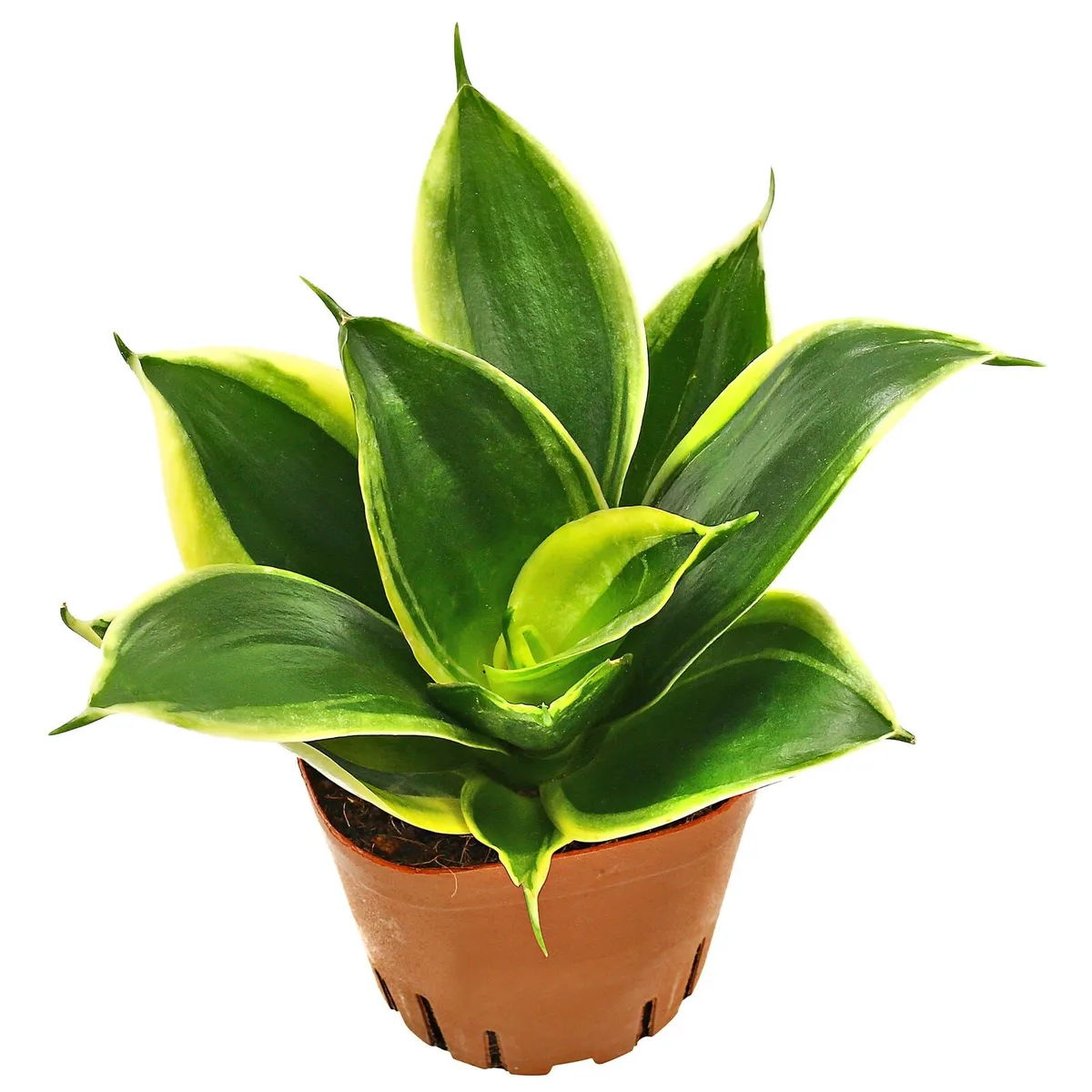
Scientific classification
- Species
- Snake Plant 'Hahnii' (Dracaena trifasciata 'Hahnii')
- Genus
- Dracaena
- Family
- Asparagaceae
- Order
- Asparagales
- Class
- Liliopsida
- Phylum
- Magnoliophyta
- Toxic if ingested, may cause mild gastrointestinal upset in pets and humans.
- Toxicity
- Houseplants · Succulent · Foliage
- Plant type
- 0.3 - 0.5 metres
- Height
- 0.3 - 0.5 metres
- Spread
- Evergreen
- Foliage
- Upright · Clump forming
- Habit
- Spring · Summer · Autumn · Winter
- Season of interest
- Bright indirect light · Partial shade
- Sunlight
- 18 – 27 °C
- Ideal temperature









Snake Plant 'Hahnii' pictures
Distribution of Snake Plant 'Hahnii'
Distribution map
- Native
- Introduced
- Cultivated
Source:WCVP v16 · Royal Botanic Gardens, Kew · CC BY 3.0 · Boundaries:WGSRPD / TDWG
Toxicity
Toxic if ingested, may cause mild gastrointestinal upset in pets and humans.
Snake Plant 'Hahnii' care guide
- Allow soil to dry completely between waterings
- Watering
- Bright indirect light · Partial shade
- Sunlight
- 18 – 27 °C
- Ideal temperature

Watering
Allow soil to dry completely between waterings
Fertilizing
 Fertilizing
Monthly during spring and summer with cactus fertilizer
Pruning
 Pruning
Remove dead or damaged leaves at the base as needed. No regular pruning is required.
Propagation
 Propagation
Divide the clumps in spring when repotting, separating off individual rosettes. Leaf cuttings can also be taken, but variegation may be lost in the offspring. Rooting is easy in moist potting mix at 20-25°C.
Growing
 Growing
Prefers well-drained, sandy soil. Water sparingly, allowing the soil to dry completely between waterings; reduce watering in winter. Thrives in bright indirect light but tolerates low light. Fertilize monthly with a balanced liquid fertilizer during the growing season. Avoid temperatures below 10°C.
Common pests and diseases
Diseases
Overwatering can cause root rot; otherwise generally disease-free.
Pests
Occasionally affected by mealybugs or spider mites.
Explore the plant health library →




