
Variegated Philodendron Birkin
Also known as: Variegated Birkin Philodendron, Birkin Philodendron
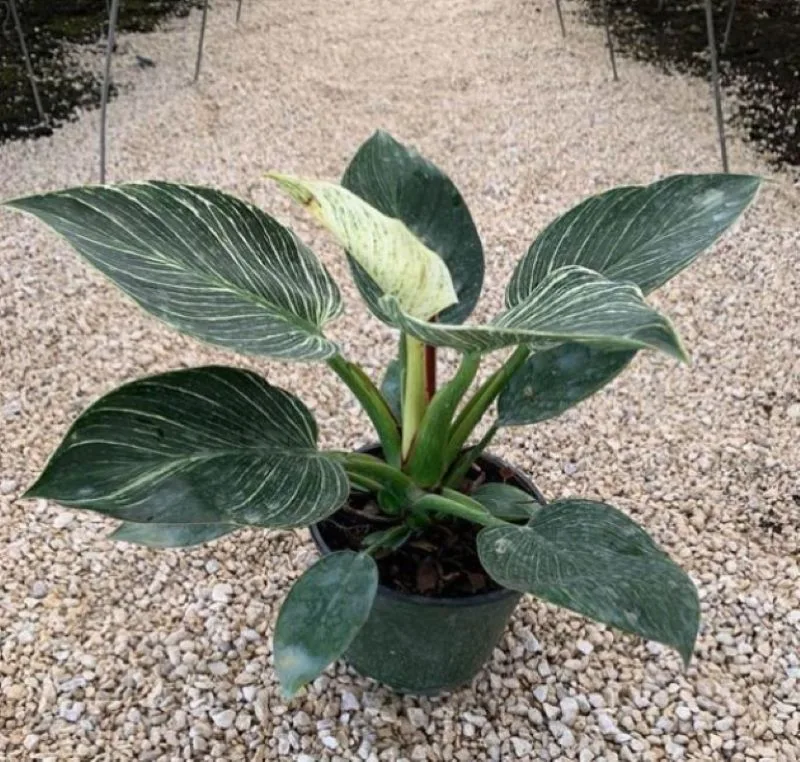
Philodendron erubescens 'Birkin' is a compact, slow-growing cultivar with striking heart-shaped leaves. The deep green foliage is boldly striped and splashed with creamy white or pale yellow variegation, often with irregular patterns. It has a semi-upright to climbing habit, with stems that can be trained on a moss pole or left to cascade. This plant is prized for its unique, dramatic foliage and is a popular choice for indoor collections.
Scientific classification
- Species
- Variegated Philodendron Birkin (Philodendron erubescens 'Birkin')
- Genus
- Philodendron
- Family
- Araceae
- Order
- Alismatales
- Class
- Liliopsida
- Phylum
- Magnoliophyta
- Toxic to humans and pets if ingested, due to calcium oxalate crystals; may cause oral irritation, swelling, and digestive upset.
- Toxicity
- Houseplants · Foliage · Climber
- Plant type
- 0.3 - 0.6 metres
- Height
- 0.3 - 0.5 metres
- Spread
- Evergreen
- Foliage
- Upright · Climbing
- Habit
- Spring · Summer · Autumn
- Season of interest
- Bright indirect light
- Sunlight
- 18 – 27 °C
- Ideal temperature









Variegated Philodendron Birkin pictures
Distribution of Variegated Philodendron Birkin
Distribution map
- Native
- Introduced
- Cultivated
Source:WCVP v16 · Royal Botanic Gardens, Kew · CC BY 3.0 · Boundaries:WGSRPD / TDWG
Toxicity
Toxic to humans and pets if ingested, due to calcium oxalate crystals; may cause oral irritation, swelling, and digestive upset.
Variegated Philodendron Birkin care guide
- Keep soil evenly moist, but not soggy
- Watering
- Bright indirect light
- Sunlight
- 18 – 27 °C
- Ideal temperature

Watering
Keep soil evenly moist, but not soggy
Fertilizing
 Fertilizing
Every 2-4 weeks during growing season
Pruning
 Pruning
Prune in spring to control size and shape, cutting back leggy stems just above a leaf node. Remove any yellow or damaged leaves to maintain appearance and health.
Propagation
 Propagation
Propagate from stem cuttings taken in spring or early summer. Cut a 10–15 cm section with 2–3 nodes, remove lower leaves, and insert into moist perlite or vermiculite. Keep in a warm, bright location (20–25°C) with high humidity; roots usually appear within 2–3 weeks. Alternatively, cuttings can be rooted in water.
Growing
 Growing
Grow in bright, indirect light; direct sun can scorch the leaves. Use a well-drained, peat-based potting mix and keep the soil lightly moist during the growing season, allowing the top inch to dry out between waterings. Reduce watering in winter. Feed monthly with a balanced liquid fertilizer from spring to early autumn. Maintain temperatures between 18–27°C and avoid cold drafts. Repot every 2–3 years as needed.
Common pests and diseases
Diseases
Susceptible to root rot and leaf spot diseases, especially when overwatered or grown in poorly drained conditions.
Pests
Common pests include spider mites, aphids, and scale insects. Regularly inspect leaves and treat promptly with insecticidal soap or neem oil.
Explore the plant health library →




