
Golden Sedum
Also known as: Golden Sedum, Sedum nussbaumerianum
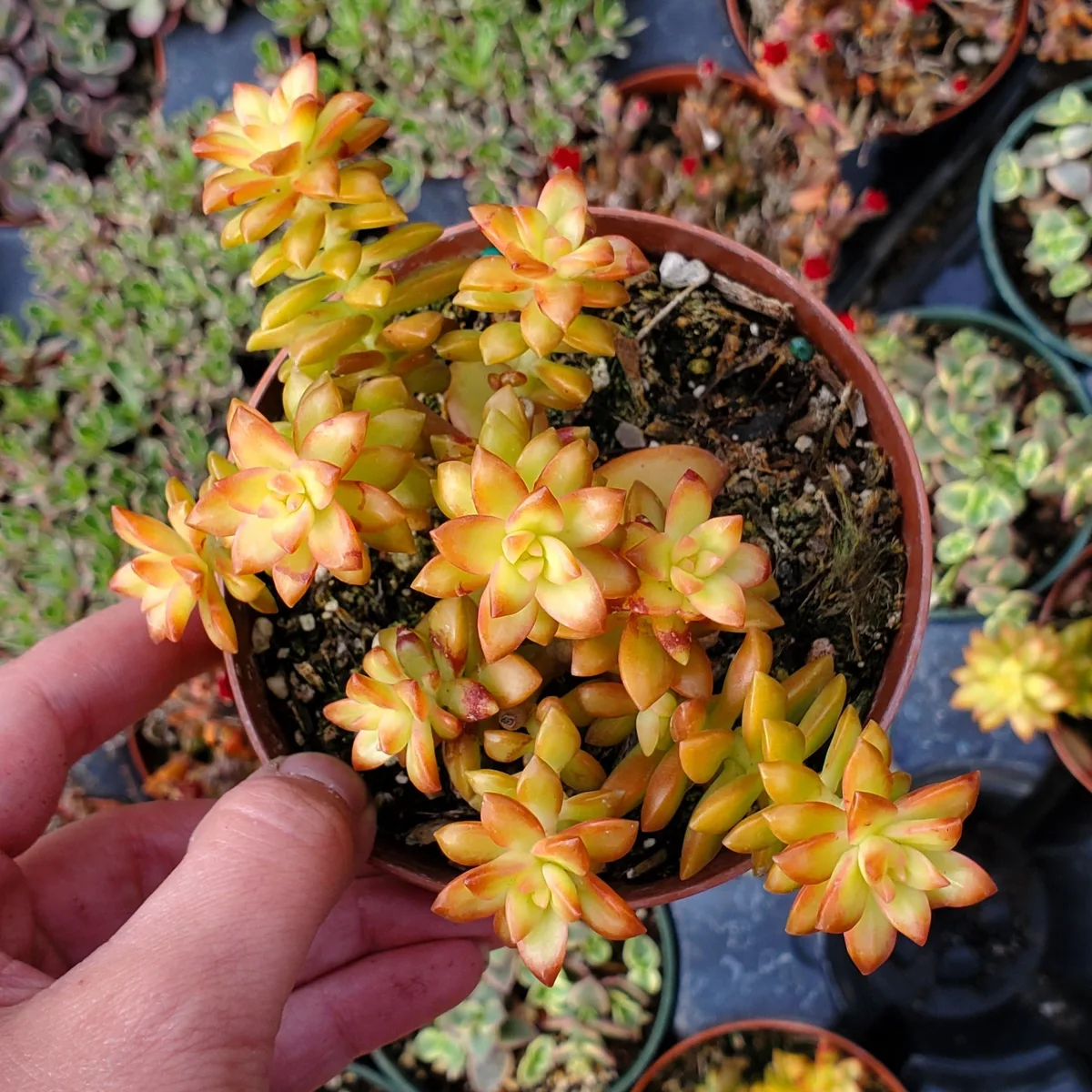
Sedum adolphii is a low-growing succulent shrub with fleshy, lance-shaped leaves that are bright golden-yellow, often tipped with orange-red when exposed to full sun. It forms dense clumps of rosettes on trailing stems, reaching about 20–30 cm in height. In spring and early summer, it produces clusters of small, star-shaped white flowers. This plant is prized for its vivid foliage colour and compact, spreading habit, making it an excellent choice for containers and ground cover.
Scientific classification
- Species
- Golden Sedum (Sedum adolphii)
- Genus
- Sedum
- Family
- Crassulaceae
- Order
- Saxifragales
- Class
- Magnoliopsida
- Phylum
- Magnoliophyta
- Non-toxic to humans and pets.
- Toxicity
- Succulent · Houseplants
- Plant type
- 0.2 - 0.3 metres
- Height
- 0.3 - 0.6 metres
- Spread
- Evergreen
- Foliage
- Spreading
- Habit
- Spring · Summer
- Season of interest
- Full sun
- Sunlight
- 15 – 25 °C
- Ideal temperature









Golden Sedum pictures
Distribution of Golden Sedum
Distribution map
Southern Mexico and Central America
Toxicity
Non-toxic to humans and pets.
Golden Sedum care guide
- Water deeply but infrequently, allow soil to dry completely between watering
- Watering
- Full sun
- Sunlight
- 15 – 25 °C
- Ideal temperature

Watering
Water deeply but infrequently, allow soil to dry completely between watering
Fertilizing
 Fertilizing
Fertilize once in spring and once in summer with low-nitrogen fertilizer
Pruning
 Pruning
Remove dead or shrivelled leaves at the base to improve air circulation and appearance. For leggy stems, prune back in early spring to encourage bushier growth.
Propagation
 Propagation
Easily propagated by leaf or stem cuttings. Take stem cuttings in spring or summer, allow them to callus for a day, then insert into well-drained gritty compost. Leaf cuttings can be placed on the soil surface; roots and new rosettes will form within a few weeks. Keep in bright indirect light and water sparingly until established.
Growing
 Growing
Grow in well-drained soil with a sandy or loamy texture; add perlite or grit to improve drainage. Water thoroughly only when the soil has dried out completely, and avoid waterlogging. Provide at least 6 hours of direct sunlight daily to maintain compact growth and vibrant leaf colour. Protect from frost; in cooler climates, overwinter indoors or in a greenhouse. Fertilise sparingly, once in spring with a balanced liquid feed diluted to half strength.
Common pests and diseases
Diseases
Susceptible to root rot and fungal diseases if overwatered or grown in poorly drained soil. Ensure good drainage and avoid wetting the leaves.
Pests
May be attacked by mealybugs and aphids, especially when grown indoors. Inspect regularly and treat with insecticidal soap or neem oil if needed.
Explore the plant health library →




