
giant viper's bugloss 'Snow Tower'
Also known as: Information to be completed
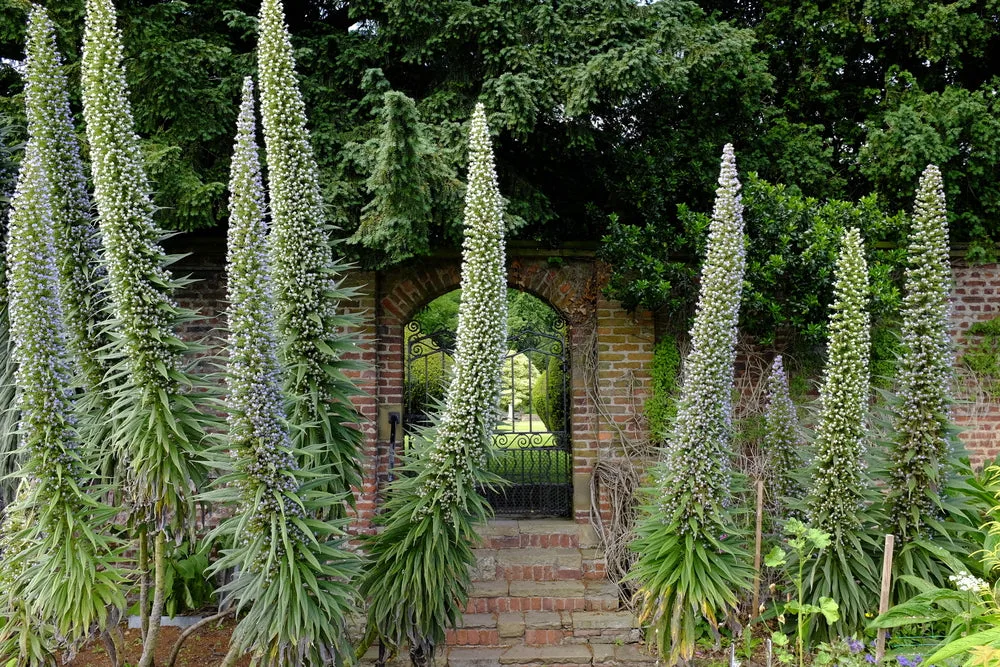
A triennial plant that in its first and second year forms a rosette to 60cm across, composed of rough, lance-shaped leaves. In its third summer it throws up a huge (3m) flower spike, densely packed with thousands of small white flowers; these are irresistible to bees
Scientific classification
- Species
- giant viper's bugloss 'Snow Tower' (Echium pininana 'Snow Tower')
- Genus
- Echium
- Family
- Boraginaceae
- Order
- Boraginales
- Class
- Magnoliopsida
- Phylum
- Magnoliophyta
- Skin irritant. Wear gloves and other protective equipment when handling
- Toxicity
- Annual Biennial · Shrubs
- Plant type
- 2.5-4 metres
- Height
- 1-1.5 metres
- Spread
- Evergreen
- Foliage
- Columnar upright
- Habit
- Spring · Summer · Autumn · Winter
- Season of interest
- Full sun
- Sunlight
- Information to be completed
- Ideal temperature









giant viper's bugloss 'Snow Tower' pictures
Distribution of giant viper's bugloss 'Snow Tower'
Distribution map
- Native
- Introduced
- Cultivated
Source:WCVP v16 · Royal Botanic Gardens, Kew · CC BY 3.0 · Boundaries:WGSRPD / TDWG
Toxicity
Skin irritant. Wear gloves and other protective equipment when handling
giant viper's bugloss 'Snow Tower' care guide
- Moderate regular watering, allowing brief slight drying between soakings
- Watering
- Full sun
- Sunlight

Watering
Moderate regular watering, allowing brief slight drying between soakings
Fertilizing
 Fertilizing
Balanced perennial feed every four weeks from spring through summer
Pruning
 Pruning
No pruning required
Propagation
 Propagation
Propagate by seed sown at 13-16°C in summer, overwintering seedlings at 5-7°C
Growing
 Growing
Grow in moderately fertile, freely-draining soil in a sheltered, sunny, warm site. Protect from winter frosts in-situ using horticultural fleece
Common pests and diseases
Diseases
Generally disease-free
Pests
May be susceptible to slugs or glasshouse whitefly and glasshouse red spider mite under glass
Explore the plant health library →




