
Variegated Burro's Tail
Also known as: Variegated Burro's Tail, Variegated Donkey's Tail
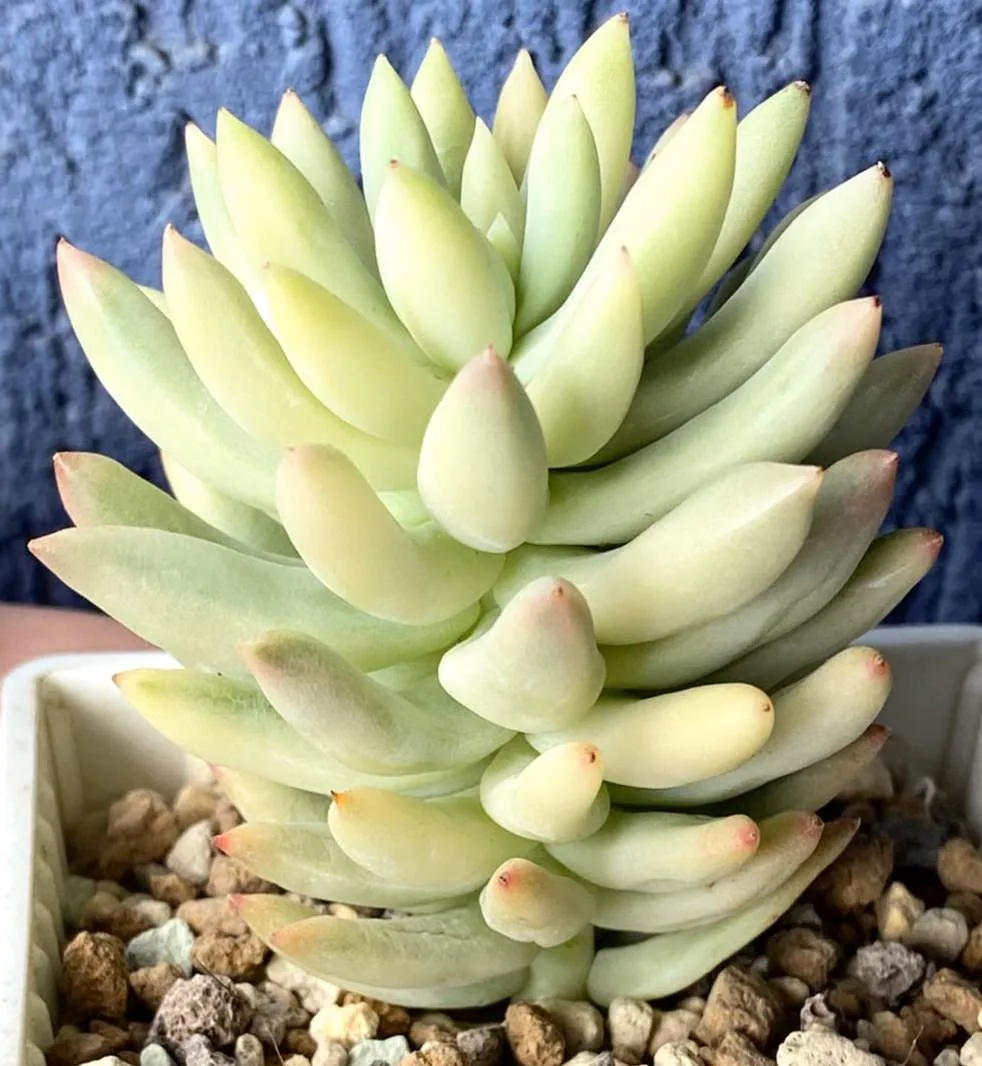
Sedum morganianum 'Variegatum' is a trailing succulent with fleshy, blue-green leaves edged in creamy white, tightly packed along slender stems that can reach up to 1 meter in length. In summer it produces small pink flowers at the tips. Its variegated foliage and cascading habit make it a popular choice for hanging baskets and containers.
Scientific classification
- Species
- Variegated Burro's Tail (Sedum morganianum 'Variegatum')
- Genus
- Information to be completed
- Family
- Crassulaceae
- Non-toxic to humans and pets.
- Toxicity
- Succulent · Houseplants
- Plant type
- 0.6 - 1 metres
- Height
- 0.3 - 0.6 metres
- Spread
- Evergreen
- Foliage
- Trailing
- Habit
- Summer
- Season of interest
- Bright indirect light · Partial shade
- Sunlight
- Information to be completed
- Ideal temperature









Variegated Burro's Tail pictures
Distribution of Variegated Burro's Tail
Distribution map
- Native
- Introduced
- Cultivated
Source:WCVP v16 · Royal Botanic Gardens, Kew · CC BY 3.0 · Boundaries:WGSRPD / TDWG
Toxicity
Non-toxic to humans and pets.
Variegated Burro's Tail care guide
- Allow soil to dry out completely between waterings
- Watering
- Bright indirect light · Partial shade
- Sunlight

Watering
Allow soil to dry out completely between waterings
Fertilizing
 Fertilizing
Every 4 weeks during growing season (spring and summer)
Pruning
 Pruning
Remove dead leaves and trim leggy stems to encourage bushiness. Pruning is rarely needed but can be done in spring.
Propagation
 Propagation
Propagate by leaf cuttings or stem cuttings in spring or autumn. Allow cuttings to callus for a few days before planting in well-draining soil. Keep slightly moist until roots develop, usually within 2-3 weeks.
Growing
 Growing
Grow in bright, indirect light or partial shade; direct harsh sun may scorch the leaves. Use a well-draining cactus or succulent potting mix. Water thoroughly only when the soil is completely dry, and reduce watering in winter. Feed with a diluted liquid succulent fertilizer every 4 weeks during spring and summer. Protect from temperatures below 10°C; suitable for indoor or greenhouse cultivation in cooler climates.
Common pests and diseases
Diseases
Susceptible to root rot and botrytis if overwatered. Good drainage is essential.
Pests
Common pests include aphids, mealybugs, and spider mites.
Explore the plant health library →




