
Pink Mussaenda
Also known as: Pink Mussaenda, Alicia Mussaenda, Variegated Mussaenda
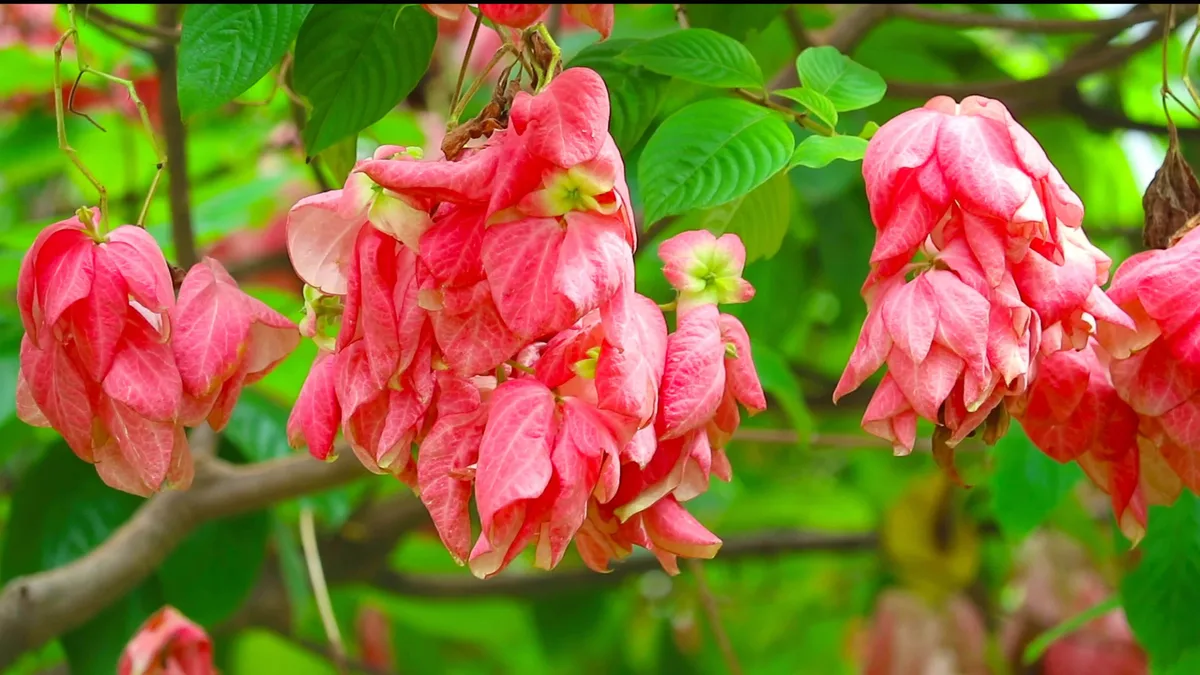
Mussaenda alicia is a bushy evergreen shrub with ovate, dark green leaves heavily splashed with creamy-white or pale pink variegation. The small, tubular yellow flowers are borne in summer but are less conspicuous than the enlarged, petal-like calyx lobes that surround them, which are typically soft pink or white. This striking foliage and colourful bracts make it a popular ornamental plant for tropical and subtropical gardens or as a conservatory specimen.
Scientific classification
- Species
- Pink Mussaenda (Mussaenda alicia)
- Genus
- Information to be completed
- Family
- Rubiaceae
- Non-toxic to humans and pets.
- Toxicity
- Shrubs · Foliage
- Plant type
- 1.5 - 2.5 metres
- Height
- 1.0 - 1.5 metres
- Spread
- Evergreen
- Foliage
- Upright · Bushy
- Habit
- Summer
- Season of interest
- Full sun · Partial shade
- Sunlight
- Information to be completed
- Ideal temperature









Pink Mussaenda pictures
Distribution of Pink Mussaenda
Distribution map
Tropical West Africa (Cameroon, Nigeria, etc.)
Toxicity
Non-toxic to humans and pets.
Pink Mussaenda care guide
- Keep soil moist during active growth, reduce in winter
- Watering
- Full sun · Partial shade
- Sunlight

Watering
Keep soil moist during active growth, reduce in winter
Fertilizing
 Fertilizing
Every 2 weeks during growing season
Pruning
 Pruning
Prune in early spring to remove weak or dead growth and to shape the plant. Cutting back old stems encourages fresh leafy growth and flowering.
Propagation
 Propagation
Propagate by semi-ripe cuttings in late spring or early summer. Take cuttings of 8-10 cm long, remove lower leaves, dip in rooting hormone and insert into a well-drained rooting medium. Keep at 20-25°C with high humidity until roots form. Alternatively, layering can be used.
Growing
 Growing
Grow in moist but well-drained, fertile loam or sandy loam in full sun to partial shade. Water regularly during the growing season, allowing the top of the compost to dry slightly between waterings in winter. Apply a balanced liquid fertilizer every two weeks from spring to late summer. Protect from temperatures below 10°C; in cool climates, grow in a heated greenhouse or as a houseplant. Pinch out growing tips to encourage bushiness.
Common pests and diseases
Diseases
Susceptible to root rot if overwatered or planted in heavy, poorly drained soil. Leaf spot may occur in humid conditions.
Pests
May be affected by aphids, spider mites and whiteflies, especially when grown under cover.
Explore the plant health library →




