
Pinellia cordata 'Yamazaki'
Also known as: Information to be completed
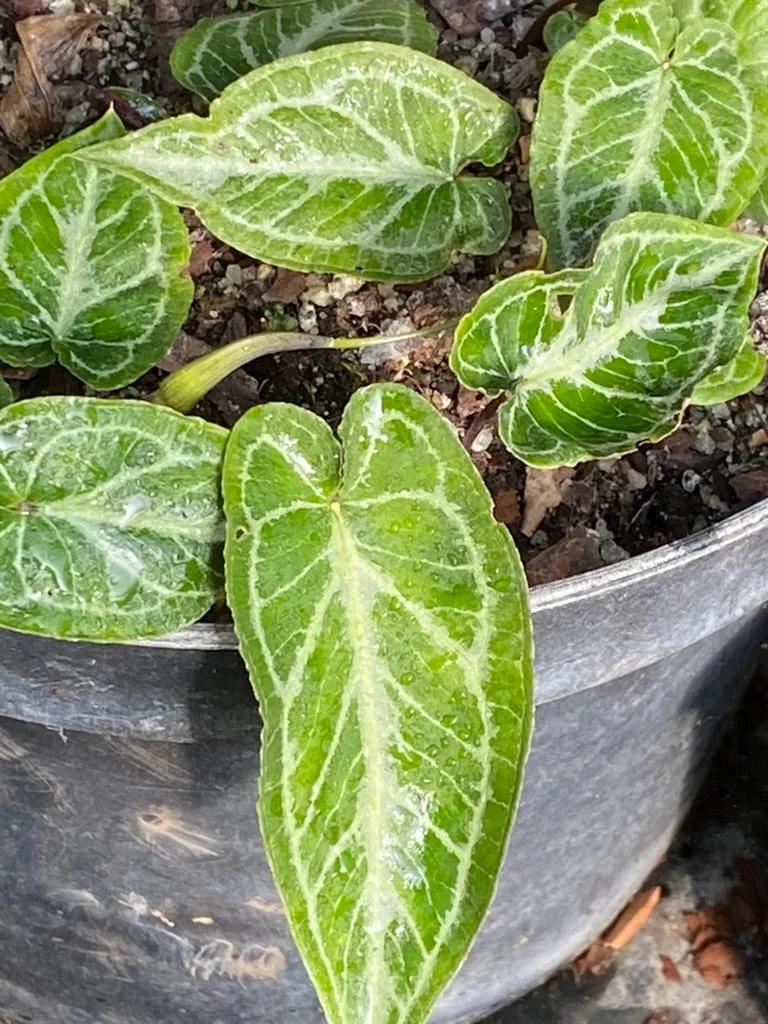
A compact tuberous perennial to around 20cm high, with long, heart-shaped dark green leaves, with paler silvery green markings on the veins and a purple flush on the undersides. In ideal conditions leaves can be up to 25cm long. Solitary, small greenish spathes, surrounding a cream-coloured spadix with a long protruding 'tail', are produced sporadically from spring to late summer in cultivation; flowers are strongly fragrant and followed by small oval-shaped green berries
Scientific classification
- Species
- Pinellia cordata 'Yamazaki' (Pinellia cordata 'Yamazaki')
- Genus
- Pinellia
- Family
- Araceae
- Order
- Alismatales
- Class
- Liliopsida
- Phylum
- Magnoliophyta
- Information to be completed
- Toxicity
- Herbaceous Perennial
- Plant type
- 0.1-0.5 metres
- Height
- 0.1-0.5 metres
- Spread
- Deciduous
- Foliage
- Clump forming
- Habit
- Spring · Summer · Autumn
- Season of interest
- Partial shade · Full shade
- Sunlight
- Information to be completed
- Ideal temperature









Pinellia cordata 'Yamazaki' pictures
Distribution of Pinellia cordata 'Yamazaki'
Distribution map
- Native
- Introduced
- Cultivated
Source:WCVP v16 · Royal Botanic Gardens, Kew · CC BY 3.0 · Boundaries:WGSRPD / TDWG
Pinellia cordata 'Yamazaki' care guide
- Moderate regular watering, avoid prolonged drought and stagnant waterlogging
- Watering
- Partial shade · Full shade
- Sunlight

Watering
Moderate regular watering, avoid prolonged drought and stagnant waterlogging
Fertilizing
 Fertilizing
Balanced perennial feed every four weeks spring through summer growth
Pruning
 Pruning
No pruning required
Propagation
 Propagation
Propagate by bulbils, which form at the base of the leaves; these are easily detached when ripe (usually as the leaves begin to wither) and must be sown straight away so they don't dry out. Alternatively, allow the bulbils to drop and transplant the young plants the following year
Growing
 Growing
Thrives in light shade in a well-drained, humus rich soil that doesn't dry out too much in summer
Common pests and diseases
Diseases
Generally disease-free
Pests
May be susceptible to slugs
Explore the plant health library →




