
White Bougainvillea
Also known as: White Bougainvillea, Paper Flower
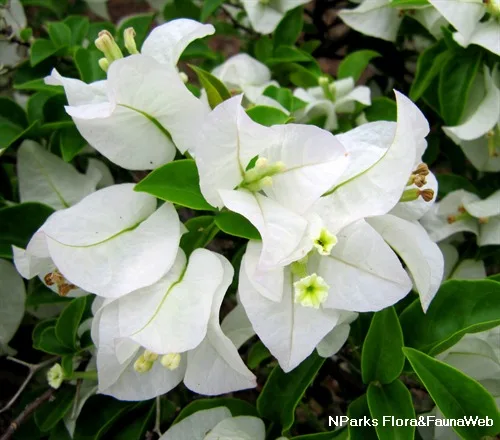
Bougainvillea glabra 'Alba' is an evergreen climbing shrub with thorny stems and ovate, pointed leaves. It produces clusters of pure white papery bracts that surround small, inconspicuous flowers. The plant has a long flowering period from summer to autumn, and can be trained to climb walls or pruned into a bushy shrub. Its vigorous growth and bright white blooms make it a standout ornamental plant for warm climates.
Scientific classification
- Species
- White Bougainvillea (Bougainvillea glabra 'Alba')
- Genus
- Information to be completed
- Family
- Nyctaginaceae
- Non-toxic. However, the thorns can cause physical injury and ingestion may result in mild stomach upset.
- Toxicity
- Climber Wall Shrub · Shrubs
- Plant type
- 1.5 - 3 metres
- Height
- 1.5 - 2 metres
- Spread
- Evergreen
- Foliage
- Climbing · Bushy
- Habit
- Summer
- Season of interest
- Full sun
- Sunlight
- Information to be completed
- Ideal temperature









White Bougainvillea pictures
Distribution of White Bougainvillea
Distribution map
- Native
- Introduced
- Cultivated
Source:WCVP v16 · Royal Botanic Gardens, Kew · CC BY 3.0 · Boundaries:WGSRPD / TDWG
Toxicity
Non-toxic. However, the thorns can cause physical injury and ingestion may result in mild stomach upset.
White Bougainvillea care guide
- Water sparingly, allow soil to dry between waterings
- Watering
- Full sun
- Sunlight

Watering
Water sparingly, allow soil to dry between waterings
Fertilizing
 Fertilizing
Every 2-4 weeks during growing season
Pruning
 Pruning
Prune after flowering to shape and remove any dead or crossing branches. For major renovation, cut back hard in early spring before new growth begins.
Propagation
 Propagation
Take semi-ripe cuttings of 10-15 cm in summer. Remove lower leaves and insert into a moist mix of perlite and sand. Maintain temperature of 20-25°C (68-77°F) and high humidity. Rooting usually occurs within 4-6 weeks.
Growing
 Growing
Plant in well-drained soil in a sunny, sheltered position. Water sparingly and allow soil to dry out between waterings; avoid overwatering which can cause root rot. Apply a balanced fertilizer every 2-4 weeks during the growing season. In cooler regions, grow in containers and overwinter indoors or in a heated greenhouse. Protect from frost, as temperatures below 0°C (32°F) can damage the plant.
Common pests and diseases
Diseases
Susceptible to root rot if overwatered or planted in poorly drained soil. Powdery mildew may occur in humid conditions with poor air circulation.
Pests
Common pests include aphids, mealybugs, and spider mites. Regular inspection and prompt treatment with insecticidal soap or neem oil can control infestations.
Explore the plant health library →




