
prayer plant 'Fascinator'
Also known as: Information to be completed
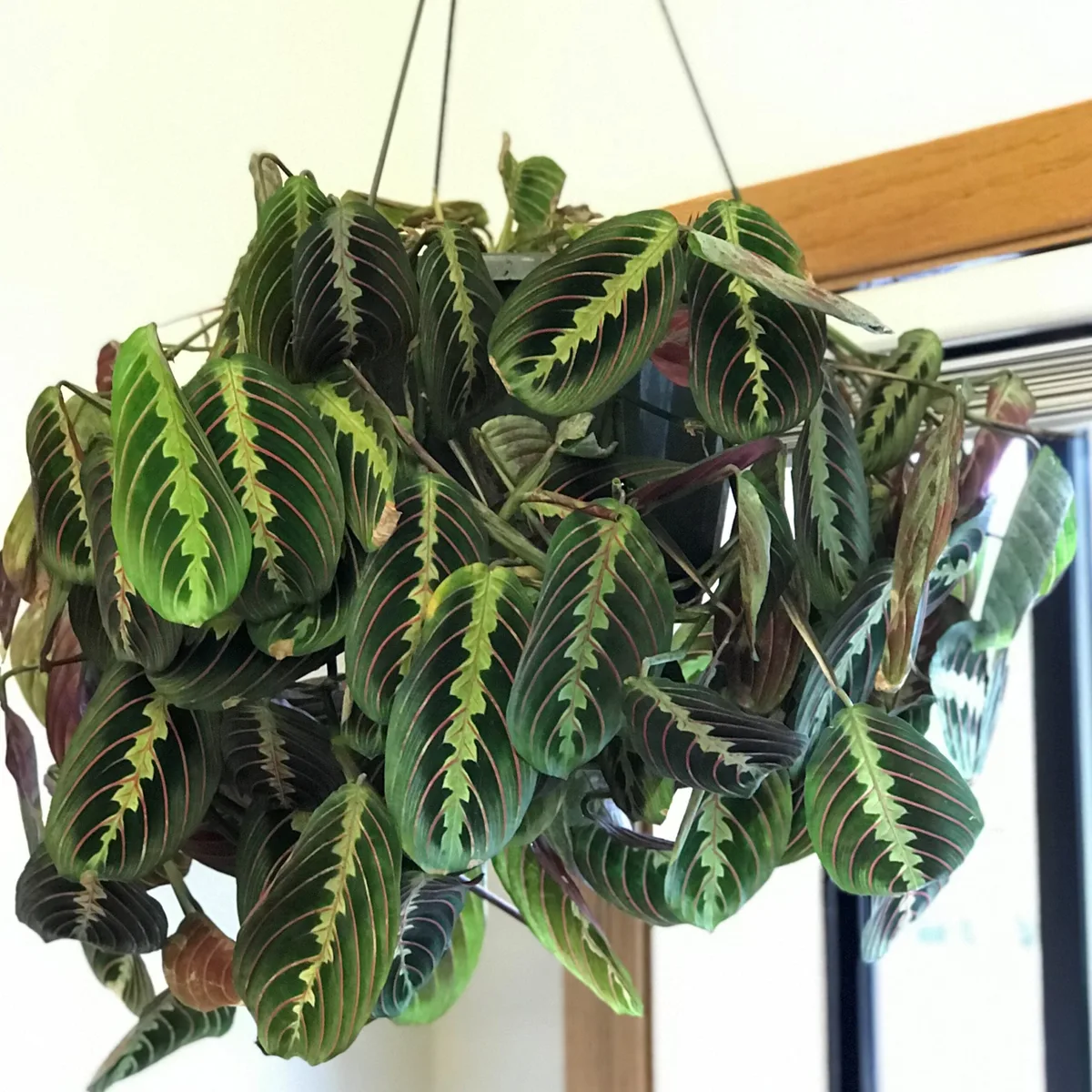
Clump-forming, tropical rainforest perennial, grown as a houseplant, to 30cm tall and wide, with elliptic to ovate dark green leaves, 12cm long, with bright red veins that fan from the midribs to the margins, and yellow-green markings along the midrib. Small tubular white flowers are produced intermittently through the year
Scientific classification
- Species
- prayer plant 'Fascinator' (Maranta leuconeura 'Fascinator')
- Genus
- Maranta
- Family
- Marantaceae
- Order
- Zingiberales
- Class
- Liliopsida
- Phylum
- Magnoliophyta
- Information to be completed
- Toxicity
- Houseplants · Conservatory Greenhouse
- Plant type
- 0.1-0.5 metres
- Height
- 0.1-0.5 metres
- Spread
- Evergreen
- Foliage
- Clump forming
- Habit
- Spring · Summer · Autumn · Winter
- Season of interest
- Partial shade
- Sunlight
- Information to be completed
- Ideal temperature









prayer plant 'Fascinator' pictures
Distribution of prayer plant 'Fascinator'
Distribution map
- Native
- Introduced
- Cultivated
Source:WCVP v16 · Royal Botanic Gardens, Kew · CC BY 3.0 · Boundaries:WGSRPD / TDWG
prayer plant 'Fascinator' care guide
- Moderate regular watering, allowing brief slight drying between soakings
- Watering
- Partial shade
- Sunlight

Watering
Moderate regular watering, allowing brief slight drying between soakings
Fertilizing
 Fertilizing
Balanced perennial feed every four weeks from spring through summer
Pruning
 Pruning
No pruning required
Propagation
 Propagation
Propagate by division in spring or by basal softwood cuttings with bottom heat in spring
Growing
 Growing
Grow in a container in peat-free potting compost, in a well-lit position that does not get direct sunlight. Water to keep the compost damp but not wet during the summer months, then cut back a little in winter. They thrive in high humidity, so either grow it in a steamy room, group with other plants, or sit the pot on a tray of dampened shingle. See houseplant cultivation
Common pests and diseases
Diseases
Generally disease-free, roots may rot if plant is overwatered
Pests
May be susceptible to glasshouse red spider mite
Explore the plant health library →




