
Iberian Montpelier maple
Also known as: Information to be completed
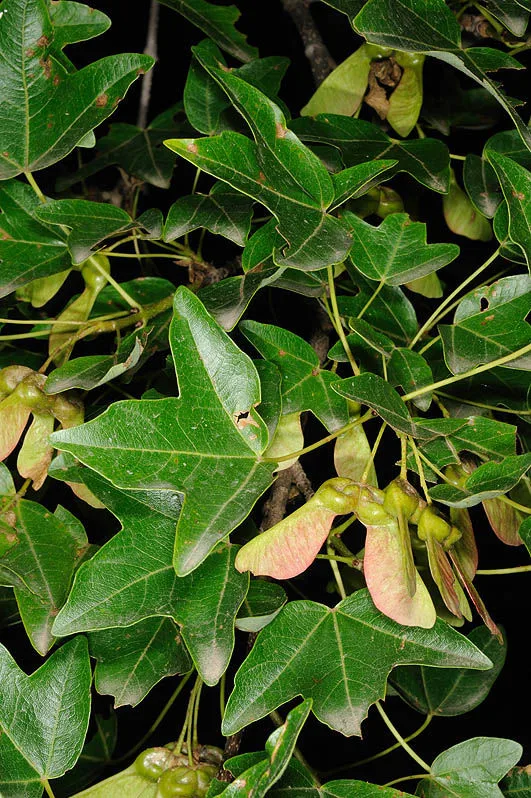
Small, deciduous tree about 8m in height, with grey bark, and initially densely covered with leathery, grey-green, 3-lobed leaves, paler and hairy beneath, produced more sparsely in maturity with strong yellow autumn leaf colour. Masses of yellow-green flowers are produced in pendent racemes, followed by red-winged fruits in midsummer
Scientific classification
- Species
- Iberian Montpelier maple (Acer monspessulanum subsp. ibericum)
- Genus
- Acer
- Family
- Sapindaceae
- Order
- Sapindales
- Class
- Magnoliopsida
- Phylum
- Magnoliophyta
- Information to be completed
- Toxicity
- Trees
- Plant type
- 4-8 metres
- Height
- 2.5-4 metres
- Spread
- Deciduous
- Foliage
- Bushy
- Habit
- Autumn · Spring · Summer
- Season of interest
- Full sun · Partial shade
- Sunlight
- Information to be completed
- Ideal temperature









Iberian Montpelier maple pictures
Distribution of Iberian Montpelier maple
Distribution map
- Native
- Introduced
- Cultivated
Source:WCVP v16 · Royal Botanic Gardens, Kew · CC BY 3.0 · Boundaries:WGSRPD / TDWG
Iberian Montpelier maple care guide
- Moderate regular watering, allowing brief slight drying between soakings
- Watering
- Full sun · Partial shade
- Sunlight

Watering
Moderate regular watering, allowing brief slight drying between soakings
Fertilizing
 Fertilizing
Balanced perennial feed every four weeks from spring through summer
Pruning
 Pruning
Little pruning is needed. Remove diseased, damaged, crowded or crossing shoots and unwanted growth. If needed, Prune only from late autumn to midwinter.
Propagation
 Propagation
Propagate by seed (trees and shrubs), layering in autumn, grafting in late winter or softwood cuttings in early summer
Growing
 Growing
Grow in fertile, moist but well-drained soil in sun or partial shade. See tree cultivation for further advice
Common pests and diseases
Diseases
May be susceptible to Verticillium wilt, Acer leaf scorch and honey fungus
Pests
May be susceptible to Acer gall mite, aphids, caterpillars and horse chestnut scale
Explore the plant health library →




