
Schrenk's tulip
Also known as: Information to be completed
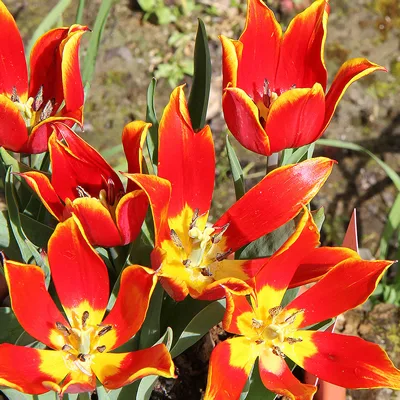
T. schrenkii is a bulbous perennial, 15cm high, with three or four glaucous leaves with wavy margins, and flowers in mid-spring which have pointed tepals that in cultivation are usually scarlet with yellow-orange margins and yellow bases but in the wild may also be pink, yellow or white
Scientific classification
- Species
- Schrenk's tulip (Tulipa schrenkii)
- Genus
- Tulipa
- Family
- Liliaceae
- Order
- Liliales
- Class
- Liliopsida
- Phylum
- Magnoliophyta
- Harmful if eaten, skin allergen. Wear gloves and other protective equipment when handling]
- Toxicity
- Bulbs
- Plant type
- 0.1-0.5 metres
- Height
- 0.1-0.5 metres
- Spread
- Deciduous
- Foliage
- Clump forming
- Habit
- Spring
- Season of interest
- Full sun
- Sunlight
- Information to be completed
- Ideal temperature









Schrenk's tulip pictures
Distribution of Schrenk's tulip
Distribution map
- Native
- Introduced
- Cultivated
Source:WCVP v16 · Royal Botanic Gardens, Kew · CC BY 3.0 · Boundaries:WGSRPD / TDWG
Toxicity
Harmful if eaten, skin allergen. Wear gloves and other protective equipment when handling]
Schrenk's tulip care guide
- Moist soil during active growth, then reduce watering after foliage yellows
- Watering
- Full sun
- Sunlight

Watering
Moist soil during active growth, then reduce watering after foliage yellows
Fertilizing
 Fertilizing
Light bulb fertilizer at emergence and again after flowering
Pruning
 Pruning
No pruning required
Propagation
 Propagation
Propagate by seed, sown in containers in a cold greenhouse or frame in autumn (it may take 4-7 years for flowers to be produced) or by division of offsets, re-planting the larger bulbs and growing on the smaller bulbs in a nursery bed, or by bulb propagation
Growing
 Growing
Plant 15-20cm deep from mid-autumn to late autumn in a rock garden or in containers, in fertile, preferably neutral or alkaline soil that is free-draining but also able to hold moisture when the bulbs are in full growth, in full sun and with shelter from strong winds; in summer, remove old yellow foliage, and keep soil dry; for more advice, see tulip cultivation
Common pests and diseases
Diseases
May be susceptible to tulip fire and bulb rot in poorly drained soil
Pests
May be susceptible to slugs, aphids and stem and bulb eelworm; squirrels may eat the bulbs
Explore the plant health library →




