
Lilium 'Miss Lucy'
Also known as: Information to be completed
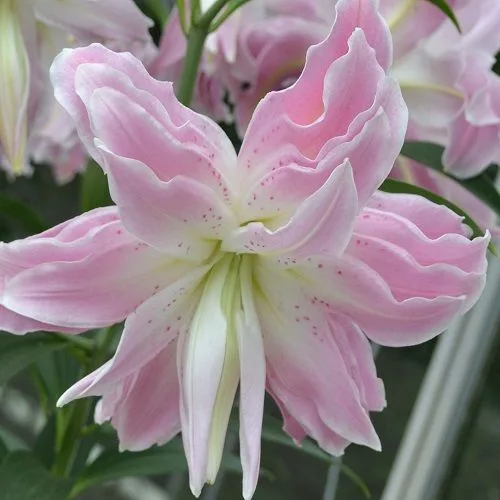
A bulbous perennial, to around 1.2m high, with upright stems and lance-shaped, glossy dark green leaves. Large, fragrant, double white flowers, very pale green towards the centre, appear in summer
Scientific classification
- Species
- Lilium 'Miss Lucy' (Lilium 'Miss Lucy')
- Genus
- Lilium
- Family
- Liliaceae
- Order
- Liliales
- Class
- Liliopsida
- Phylum
- Magnoliophyta
- Ornamental bulbs - not to be eaten. Wear gloves and other protective equipment when handling
- Toxicity
- Bulbs · Herbaceous Perennial
- Plant type
- 1-1.5 metres
- Height
- 0.1-0.5 metres
- Spread
- Deciduous
- Foliage
- Columnar upright
- Habit
- Spring · Summer · Autumn
- Season of interest
- Full sun · Partial shade
- Sunlight
- Information to be completed
- Ideal temperature









Lilium 'Miss Lucy' pictures
Toxicity
Ornamental bulbs - not to be eaten. Wear gloves and other protective equipment when handling
Lilium 'Miss Lucy' care guide
- Steady mild soil dampness, avoid complete substrate dehydration
- Watering
- Full sun · Partial shade
- Sunlight

Watering
Steady mild soil dampness, avoid complete substrate dehydration
Fertilizing
 Fertilizing
Diluted lily bulb feed every three spring-summer growing weeks
Pruning
 Pruning
Deadhead after flowering. Cut back stems when foliage dies down
Propagation
 Propagation
Propagate by division or scaling, see bulb propagation for details
Growing
 Growing
Grow in well-drained soil enriched with leaf mould or well-rotted organic matter. Ideally, grow in full sun with the base of the plant in shade. Suitable for containers, see growing lilies for more advice
Common pests and diseases
Diseases
May be susceptible to various fungal infections, including grey moulds, and virus diseases; see lily diseases for more details
Pests
May be susceptible to lily beetle, aphids, slugs, thrips, leatherjackets and wireworms, as well as small mammals such as rabbits and voles
Explore the plant health library →




