
sweet-scented tobacco plant
Also known as: tuberose-flowered tobacco plant
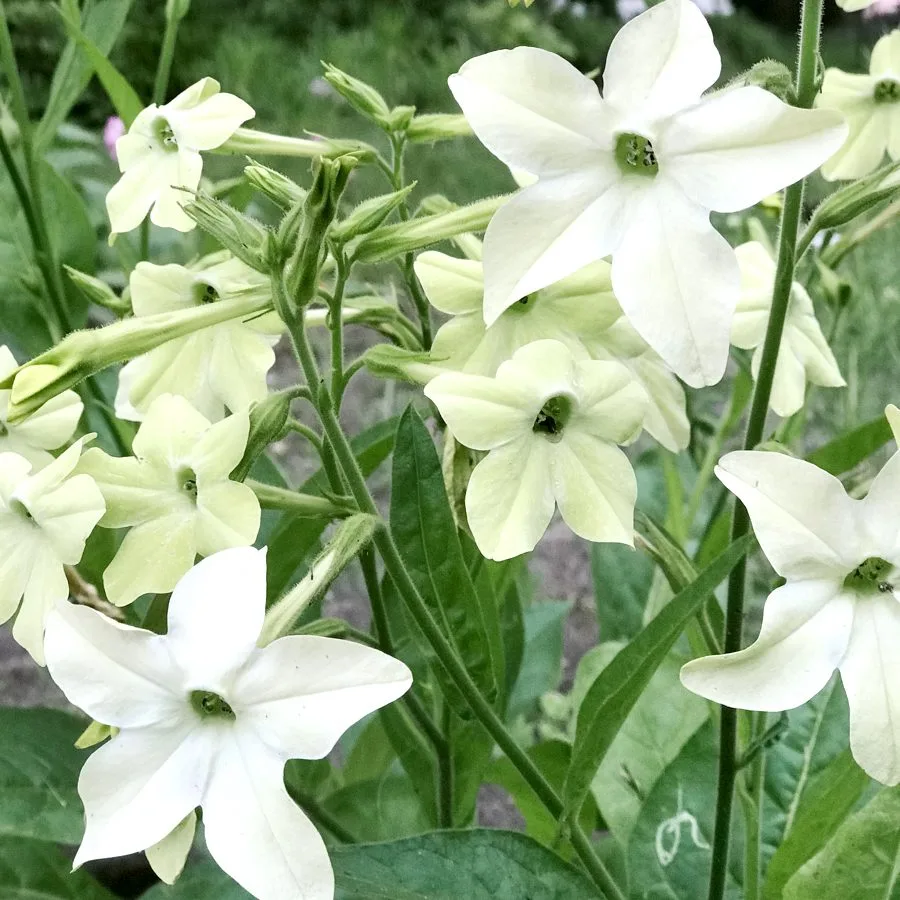
A short-lived perennial to a height of 1.5m, with spoon-shaped dark green leaves, large at the base, becoming smaller higher up. Throughout summer and into autumn, tubular creamy-white flowers with funnel-shaped mouths appear and are highly scented at night
Scientific classification
- Species
- sweet-scented tobacco plant (Nicotiana alata 'Grandiflora')
- Genus
- Nicotiana
- Family
- Solanaceae
- Order
- Solanales
- Class
- Magnoliopsida
- Phylum
- Magnoliophyta
- Harmful if eaten, avoid skin contact. Wear gloves and other protective equipment when handling]
- Toxicity
- Bedding · Herbaceous Perennial
- Plant type
- 1-1.5 metres
- Height
- 0.1-0.5 metres
- Spread
- Deciduous
- Foliage
- Columnar upright
- Habit
- Spring · Summer · Autumn
- Season of interest
- Full sun · Partial shade
- Sunlight
- Information to be completed
- Ideal temperature









sweet-scented tobacco plant pictures
Distribution of sweet-scented tobacco plant
Distribution map
- Native
- Introduced
- Cultivated
Source:WCVP v16 · Royal Botanic Gardens, Kew · CC BY 3.0 · Boundaries:WGSRPD / TDWG
Toxicity
Harmful if eaten, avoid skin contact. Wear gloves and other protective equipment when handling]
sweet-scented tobacco plant care guide
- Moderate regular watering, allowing brief slight drying between soakings
- Watering
- Full sun · Partial shade
- Sunlight

Watering
Moderate regular watering, allowing brief slight drying between soakings
Fertilizing
 Fertilizing
Balanced perennial feed every four weeks from spring through summer
Pruning
 Pruning
No pruning required
Propagation
 Propagation
Propagate by seed. Surface sow seeds, do not exclude light. Germinate at 18°C (64°F)
Growing
 Growing
Grow in fertile, moist but well-drained soil in full sun or partial shade
Common pests and diseases
Diseases
May be susceptible to grey moulds and to virus diseases
Pests
May be susceptible to aphids, glasshouse leafhoppers and glasshouse whitefly
Explore the plant health library →




