
lesser periwinkle 'Marie'
Also known as: Information to be completed
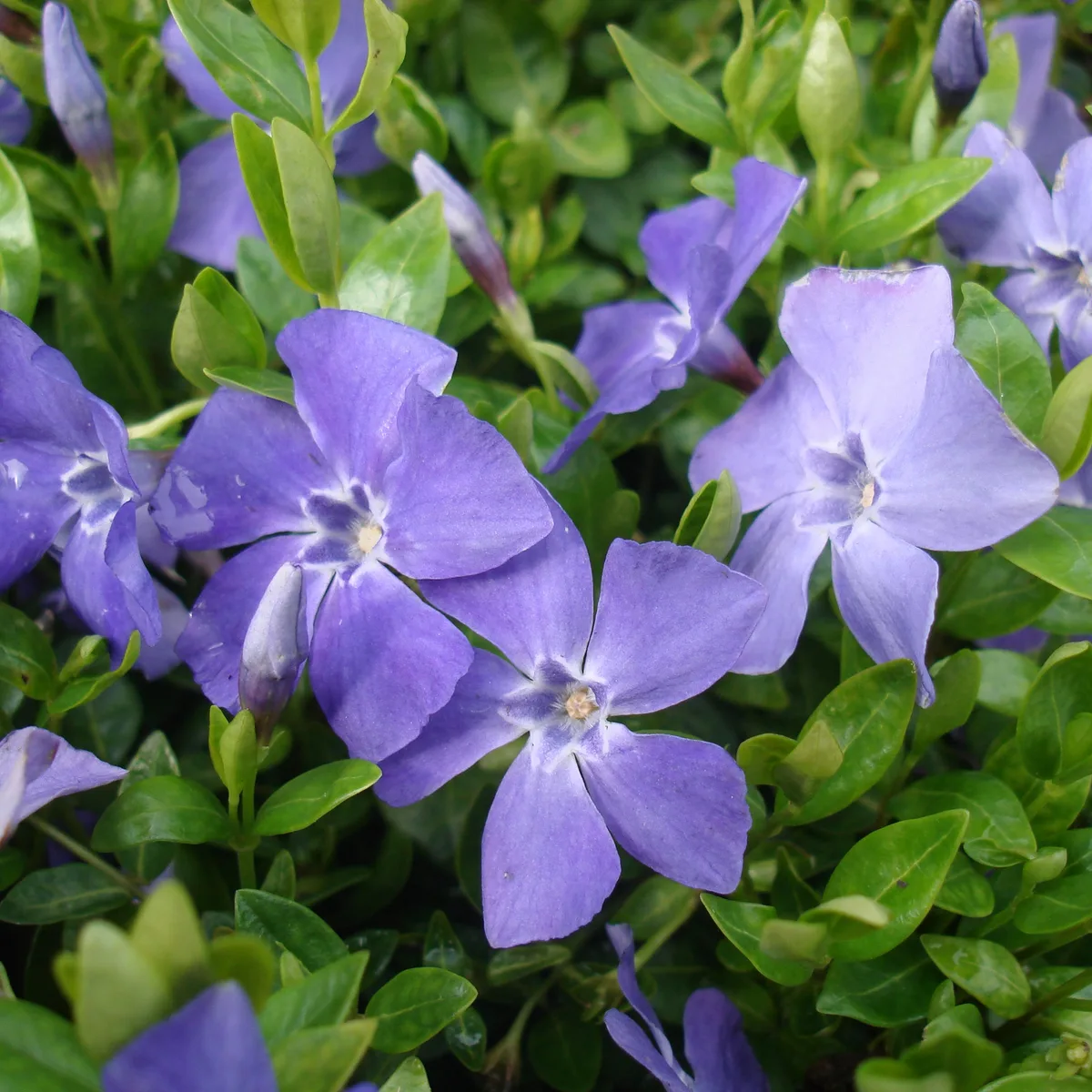
Marie' is dense, hardy variety which grows flat, perfect for ground cover. Small, dark green leaves appear in the spring followed by large, windmill-shaped royal blue flowers
Scientific classification
- Species
- lesser periwinkle 'Marie' (Vinca minor 'Marie')
- Genus
- Vinca
- Family
- Apocynaceae
- Order
- Gentianales
- Class
- Magnoliopsida
- Phylum
- Magnoliophyta
- Information to be completed
- Toxicity
- Shrubs
- Plant type
- 0.1-0.5 metres
- Height
- 0.5-1 metres
- Spread
- Evergreen
- Foliage
- Matforming
- Habit
- Spring · Summer
- Season of interest
- Full shade · Full sun · Partial shade
- Sunlight
- Information to be completed
- Ideal temperature









lesser periwinkle 'Marie' pictures
Distribution of lesser periwinkle 'Marie'
Distribution map
- Native
- Introduced
- Cultivated
Source:WCVP v16 · Royal Botanic Gardens, Kew · CC BY 3.0 · Boundaries:WGSRPD / TDWG
lesser periwinkle 'Marie' care guide
- Moderate regular watering, allowing brief slight drying between soakings
- Watering
- Full shade · Full sun · Partial shade
- Sunlight

Watering
Moderate regular watering, allowing brief slight drying between soakings
Fertilizing
 Fertilizing
Balanced perennial feed every four weeks from spring through summer
Pruning
 Pruning
Shorten last year's flowering stems to one or two buds from the older woody framework. Remove thin, weak and dead shoots. Prune in early to mid-spring as growth resumes; avoid winter pruning that exposes new shoots to frost.
Propagation
 Propagation
Propagate by division in spring or autumn and by semi-hardwood cuttings in summer
Growing
 Growing
Easy to grow in all but the driest soils. Flowers best in full sun but very useful for shady areas. May have the potential to become a nuisance if not managed well
Common pests and diseases
Diseases
May be subject to a rust
Pests
May be attacked by aphids
Explore the plant health library →




