
sage 'Phyllis' Fancy'
Also known as: Information to be completed
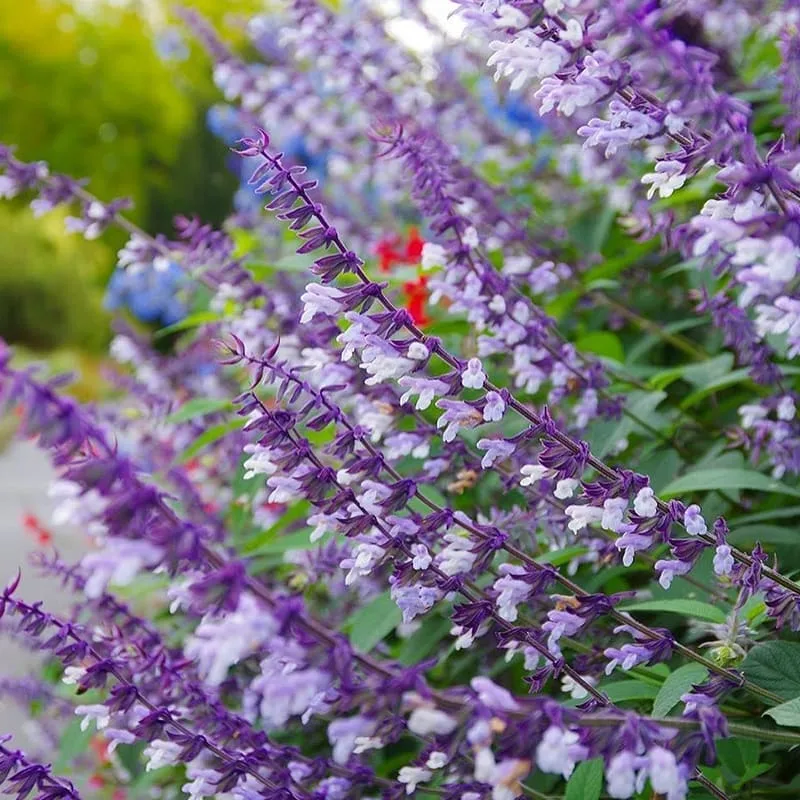
Phyllis' Fancy' is a bushy, upright plant to 2m, with aromatic, slender, deeply-veined, bright to mid green leaves. Downy, white, tubular flowers are suffused with a lavender-blue tint (which becomes more pronounced as their long season progresses) and emerge from blue-purple calyces
Scientific classification
- Species
- sage 'Phyllis' Fancy' (Salvia 'Phyllis' Fancy')
- Genus
- Salvia
- Family
- Lamiaceae
- Order
- Lamiales
- Class
- Magnoliopsida
- Phylum
- Tracheophyta
- Information to be completed
- Toxicity
- Herbaceous Perennial
- Plant type
- 1.5-2.5 metres
- Height
- 0.5-1 metres
- Spread
- Evergreen
- Foliage
- Bushy
- Habit
- Spring · Summer · Autumn · Winter
- Season of interest
- Full sun
- Sunlight
- Information to be completed
- Ideal temperature









sage 'Phyllis' Fancy' pictures
sage 'Phyllis' Fancy' care guide
- Water deeply after substrate surface dries partially each cycle
- Watering
- Full sun
- Sunlight

Watering
Water deeply after substrate surface dries partially each cycle
Fertilizing
 Fertilizing
Low-nitrogen salvia liquid feed biweekly spring and summer
Pruning
 Pruning
Prune lightly as needed to remove unwanted shoots and keep the shrub in shape. Prune in mid- to late spring.
Propagation
 Propagation
Propagate by softwood cuttings in spring or semi-ripe cuttings in late summer
Growing
 Growing
Grow in light, moderately fertile, well-drained soil in a sheltered position with full sun. Very attractive to pollinating insects. Drought tolerant. Best overwintered under glass, grow in loamless or loam-based potting compost (JI No.2) with added grit and full light
Common pests and diseases
Diseases
May be susceptible to honey fungus (rarely), powdery mildews, verticillium wilt and foot and root rots
Pests
May be susceptible to rosemary beetle and leafhoppers and slug and snail damage on young growth. Under glass may be susceptible to aphids, glasshouse whitefly and glasshouse red spider mite
Explore the plant health library →




