
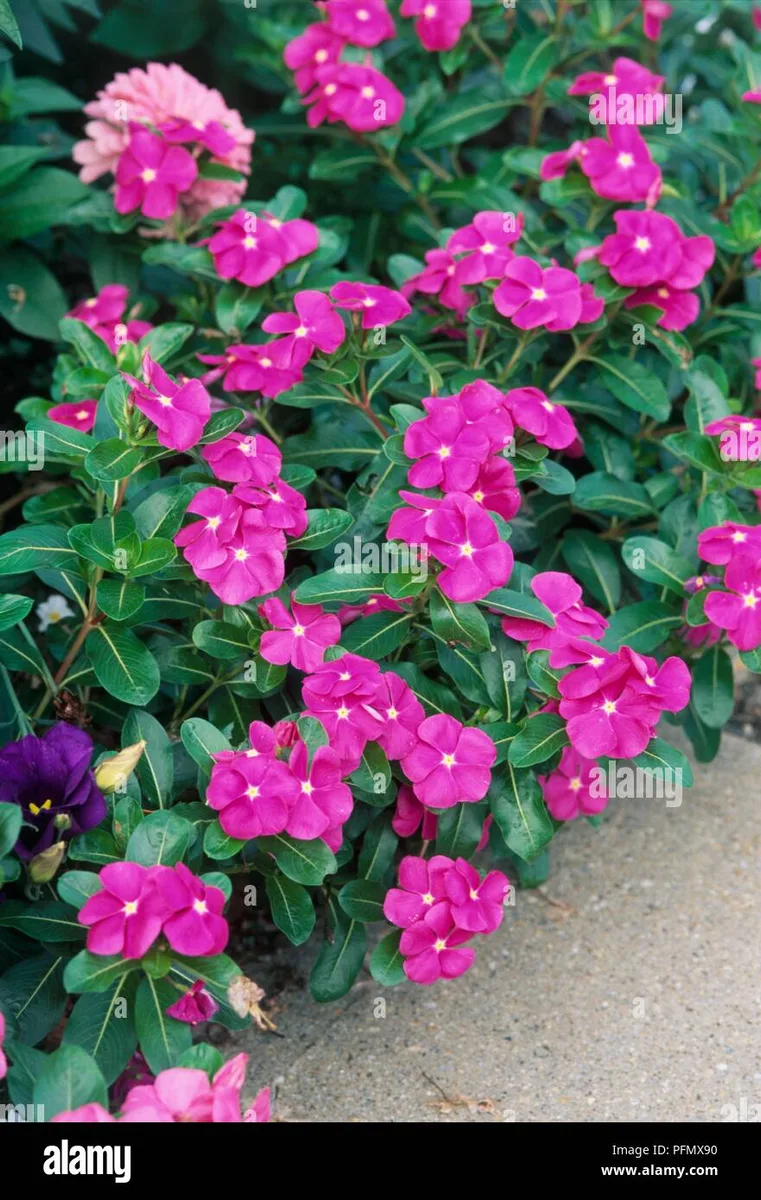
Madagascar periwinkle 'Pretty in Pink'
Also known as: Information to be completed
A frost tender, sprawling, herbaceous perennial or sub-shrub growing from 30-100cm in height. The dark green leathery leaves are arranged in opposite pairs along the stem. The attractive five petalled flowers are a deep magenta pink. Cut stems exude a white latex, which like many other plants in the Apocynaceae family, is highly toxic
Scientific classification
- Species
- Madagascar periwinkle 'Pretty in Pink' (Catharanthus roseus 'Pretty in Pink')
- Genus
- Catharanthus
- Family
- Apocynaceae
- Order
- Gentianales
- Class
- Magnoliopsida
- Phylum
- Magnoliophyta
- All parts of the plants are highly toxic, including the sap. Wear gloves and wash hands after handling
- Toxicity
- Herbaceous Perennial
- Plant type
- 0.5-1 metres
- Height
- 0.5-1 metres
- Spread
- Evergreen
- Foliage
- Bushy
- Habit
- Spring · Summer · Autumn · Winter
- Season of interest
- Full sun · Partial shade
- Sunlight
- Information to be completed
- Ideal temperature









Madagascar periwinkle 'Pretty in Pink' pictures
Distribution of Madagascar periwinkle 'Pretty in Pink'
Distribution map
- Native
- Introduced
- Cultivated
Source:WCVP v16 · Royal Botanic Gardens, Kew · CC BY 3.0 · Boundaries:WGSRPD / TDWG
Toxicity
All parts of the plants are highly toxic, including the sap. Wear gloves and wash hands after handling
Madagascar periwinkle 'Pretty in Pink' care guide
- Moderate regular watering, allowing brief slight drying between soakings
- Watering
- Full sun · Partial shade
- Sunlight

Watering
Moderate regular watering, allowing brief slight drying between soakings
Fertilizing
 Fertilizing
Balanced perennial feed every four weeks from spring through summer
Pruning
 Pruning
No pruning required
Propagation
 Propagation
Propagate by seed in containers at 22-25C and kept in the dark until germination, or from semi-ripe tip cuttings in summer and autumn and inserted into a light well drained compost
Growing
 Growing
Of easy cultivation, requiring a well drained, but moisture retentive soil in full sun or partial shade. Prefers growing temperatures around 25C with high humidity
Common pests and diseases
Diseases
May be susceptible to phytophthora root rot in poorly drained soils
Pests
May be susceptible to glasshouse red spider mite under glass
Explore the plant health library →




