
Kraus's clubmoss 'Golden Tips'
Also known as: Information to be completed
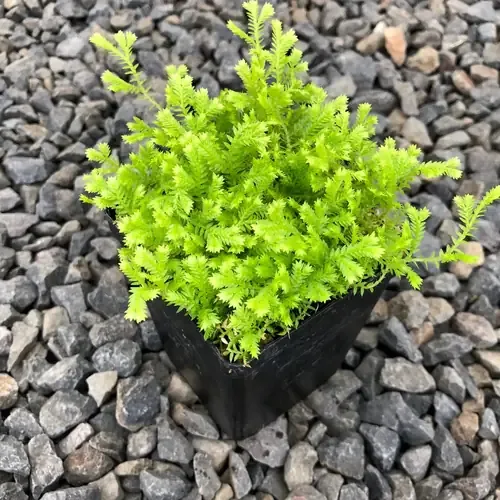
A form of spikemoss or lesser clubmoss. A non-flowering, rhizomatous, mat-forming perennial, up to 5cm high, with trailing stems up to 30cm long, rooting from the nodes so that they may be infinitely spreading, and branching into evergreen, frond-like sprays of green leaves with yellow-green growing tips
Scientific classification
- Species
- Kraus's clubmoss 'Golden Tips' (Selaginella kraussiana 'Gold Tips')
- Genus
- Selaginella
- Family
- Selaginellaceae
- Order
- Selaginellales
- Class
- Lycopodiopsida
- Phylum
- Lycopodiophyta
- Information to be completed
- Toxicity
- Herbaceous Perennial · Conservatory Greenhouse
- Plant type
- Up to 10 cm
- Height
- 0.5-1 metres
- Spread
- Evergreen
- Foliage
- Matforming
- Habit
- Spring · Summer · Autumn · Winter
- Season of interest
- Partial shade
- Sunlight
- Information to be completed
- Ideal temperature









Kraus's clubmoss 'Golden Tips' pictures
Distribution of Kraus's clubmoss 'Golden Tips'
Distribution map
- Native
- Introduced
- Cultivated
Source:WCVP v16 · Royal Botanic Gardens, Kew · CC BY 3.0 · Boundaries:WGSRPD / TDWG
Kraus's clubmoss 'Golden Tips' care guide
- Moderate regular watering, avoid prolonged drought or waterlogging
- Watering
- Partial shade
- Sunlight

Watering
Moderate regular watering, avoid prolonged drought or waterlogging
Fertilizing
 Fertilizing
Balanced feed in spring and light repeat in growth season
Pruning
 Pruning
No pruning required
Propagation
 Propagation
Propagate by spores, sown at 21°C as soon as they are ripe, or by division of rhizomes or rooted stems in spring, or by layering; for more advice on propagation by spores, see hardy fern cultivation
Growing
 Growing
In milder frost-free areas, grow outdoors in moderately fertile, humus-rich, neutral to slightly acidic, moist but well-drained soil in partial shade, with shelter from cold drying winds; in colder areas, grow under glass, in bright filtered or indirect light and high humidity, but with good air circulation, in a rapidly draining, coarse, open medium rich in organic matter, for example a loam-based medium, such as John Innes No. 2, with additional leafmould, bark, sharp sand or fine grit and some charcoal, and when growing water freely and apply a balanced liquid fertilizer monthly, but keep just moist in winter
Common pests and diseases
Diseases
Generally disease-free
Pests
Generally pest-free but may be affected by slugs
Explore the plant health library →




