
Bergenia crassifolia 'Aureo-Marginata'
Also known as: Information to be completed
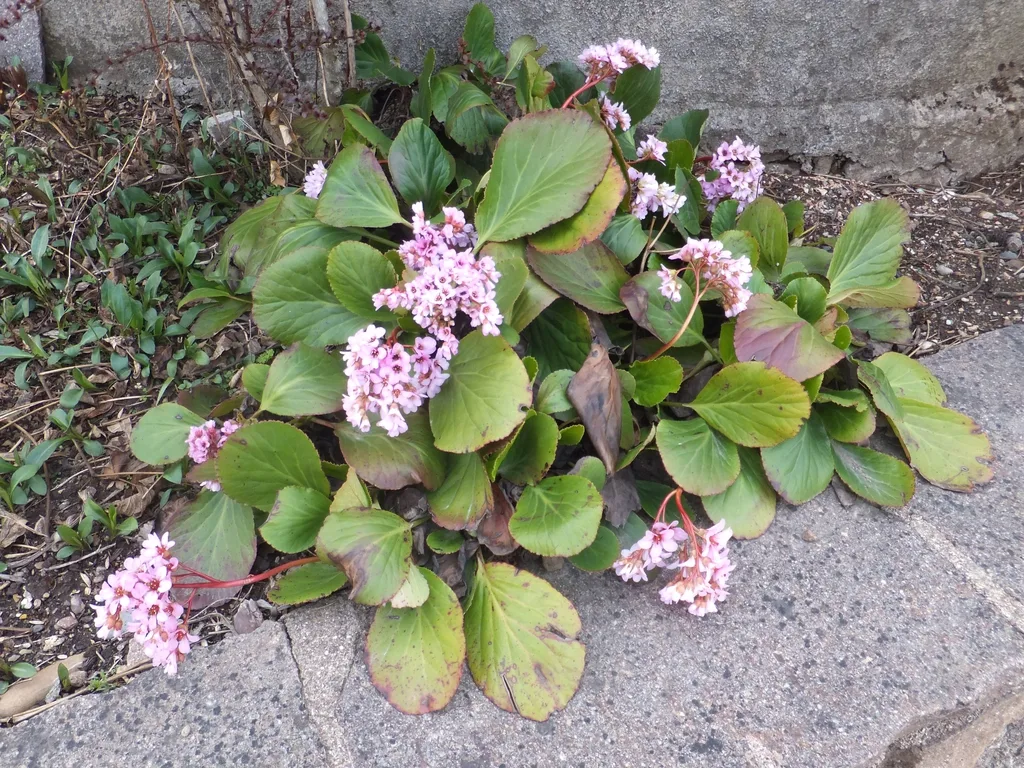
Clump-forming evergreen perennial about 45cm tall. Broadly oval, mid-green leaves to 18cm long, streaked cream and purple, with bristly, reddish edges, are red-tinged in exposed sites, especially in winter. Branched reddish-green stems bear dense clusters of purplish-pink flowers, in late winter and early spring
Scientific classification
- Species
- Bergenia crassifolia 'Aureo-Marginata' (Bergenia crassifolia 'Aureo-Marginata')
- Genus
- Bergenia
- Family
- Saxifragaceae
- Order
- Saxifragales
- Class
- Magnoliopsida
- Phylum
- Magnoliophyta
- Information to be completed
- Toxicity
- Herbaceous Perennial
- Plant type
- 0.1-0.5 metres
- Height
- 0.1-0.5 metres
- Spread
- Evergreen
- Foliage
- Clump forming
- Habit
- Autumn · Winter · Spring · Summer
- Season of interest
- Full sun · Partial shade
- Sunlight
- Information to be completed
- Ideal temperature









Bergenia crassifolia 'Aureo-Marginata' pictures
Distribution of Bergenia crassifolia 'Aureo-Marginata'
Distribution map
- Native
- Introduced
- Cultivated
Source:WCVP v16 · Royal Botanic Gardens, Kew · CC BY 3.0 · Boundaries:WGSRPD / TDWG
Bergenia crassifolia 'Aureo-Marginata' care guide
- Maintain slightly damp soil, tolerate brief dry spells in cool shaded spots
- Watering
- Full sun · Partial shade
- Sunlight

Watering
Maintain slightly damp soil, tolerate brief dry spells in cool shaded spots
Fertilizing
 Fertilizing
Light balanced feed once yearly at early spring before new foliage emerges
Pruning
 Pruning
Remove faded flower spikes and leaves to keep plants tidy
Propagation
 Propagation
Propagate by division of established clumps, or root rhizomes sections in autumn or spring
Growing
 Growing
Grow in humus-rich, moist but well drained soil in sun or part shade. Grow in sun for best autumn leaf colour. Tolerates poor soil, exposed sites and shady areas, dislikes hot dry conditions. See bergenia cultivation
Common pests and diseases
Diseases
May be susceptible to a leaf spot (fungal)
Pests
May be susceptible to vine weevil and slugs and snails
Explore the plant health library →




