
Cautleya cathcartii 'Tenzing's Gold'
Also known as: Information to be completed
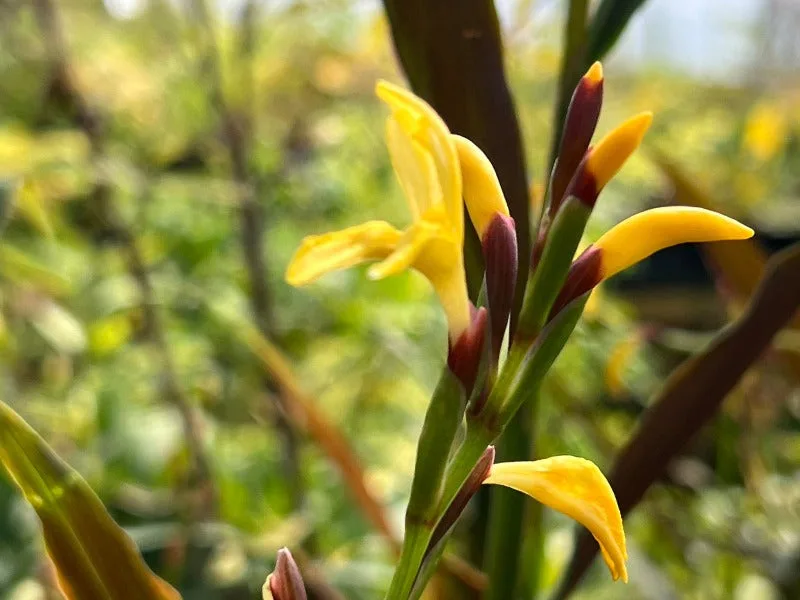
A decidous, clump-forming, exotic-looking perennial with lance-shaped green leaves that have purple-red undersides. Stems, to a height of 55cm (21.5in), bear spikes of yellow-orange flowers, that emerge from red-tinted bracts in mid-summer and autumn.
Scientific classification
- Species
- Cautleya cathcartii 'Tenzing's Gold' (Cautleya cathcartii 'Tenzing's Gold')
- Genus
- Cautleya
- Family
- Zingiberaceae
- Order
- Zingiberales
- Class
- Liliopsida
- Phylum
- Magnoliophyta
- Information to be completed
- Toxicity
- Herbaceous Perennial
- Plant type
- 0.1-0.5 metres
- Height
- 1-1.5 metres
- Spread
- Deciduous
- Foliage
- Clump forming
- Habit
- Spring · Summer · Autumn
- Season of interest
- Partial shade · Full sun
- Sunlight
- Information to be completed
- Ideal temperature









Cautleya cathcartii 'Tenzing's Gold' pictures
Distribution of Cautleya cathcartii 'Tenzing's Gold'
Distribution map
- Native
- Introduced
- Cultivated
Source:WCVP v16 · Royal Botanic Gardens, Kew · CC BY 3.0 · Boundaries:WGSRPD / TDWG
Cautleya cathcartii 'Tenzing's Gold' care guide
- Moderate regular watering, allowing brief slight drying between soakings
- Watering
- Partial shade · Full sun
- Sunlight

Watering
Moderate regular watering, allowing brief slight drying between soakings
Fertilizing
 Fertilizing
Balanced perennial feed every four weeks from spring through summer
Pruning
 Pruning
No pruning required. Remove withered foliage in autumn/winter.
Propagation
 Propagation
Propagate by seed sown underglass/indoors at 15-20°C (18-64°F) in early spring. Propagate by division in late spring just after growth has emerged.
Growing
 Growing
Grow in partial-shade, or with protection from midday sun, in a sheltered position on soil rich in organic matter. Protect in cold/frost-prone areas with a deep mulch of organic matter in winter.
Common pests and diseases
Diseases
Generally disease-free
Pests
May be susceptible to slugs and snails
Explore the plant health library →




