
Hemerocallis 'Troubled Sleep'
Also known as: Information to be completed
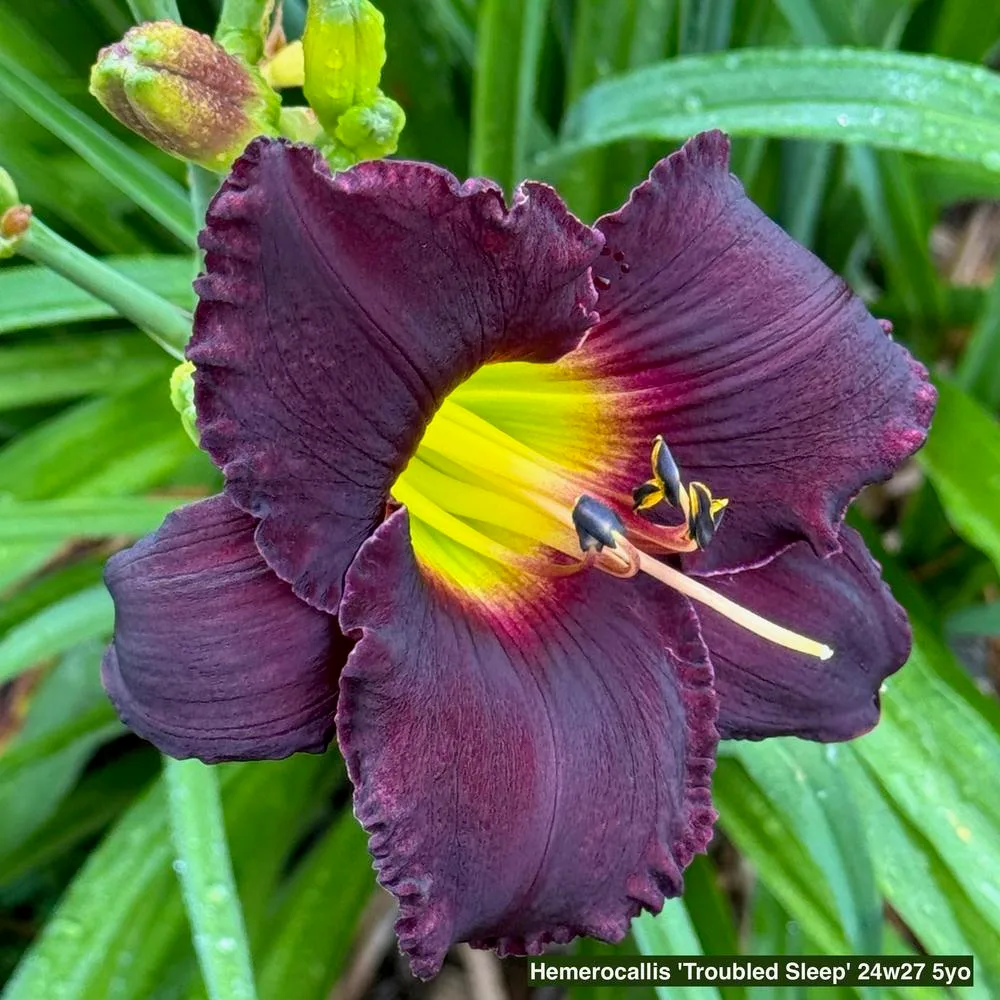
A semi-evergreen, clump-forming herbaceous perennial with strap-shaped, arching mid-green leaves. Flowers are dark red-purple with a yellow green throat and have reflexed petals
Scientific classification
- Species
- Hemerocallis 'Troubled Sleep' (Hemerocallis 'Troubled Sleep')
- Genus
- Hemerocallis
- Family
- Asphodelaceae
- Information to be completed
- Toxicity
- Herbaceous Perennial
- Plant type
- 0.5-1 metres
- Height
- 0.1-0.5 metres
- Spread
- Semi evergreen
- Foliage
- Clump forming
- Habit
- Spring · Summer · Autumn
- Season of interest
- Full sun · Partial shade
- Sunlight
- Information to be completed
- Ideal temperature









Hemerocallis 'Troubled Sleep' pictures
Distribution of Hemerocallis 'Troubled Sleep'
Distribution map
Information to be completed
Information to be completed
Culture
Information to be completed
Toxicity
Information to be completed
Quick identification of Hemerocallis 'Troubled Sleep'
Information to be completed
Hemerocallis 'Troubled Sleep' care guide
- Keep soil evenly moist during active growth and flowering season
- Watering
- Full sun · Partial shade
- Sunlight
- Information to be completed
- Ideal temperature

Watering
Keep soil evenly moist during active growth and flowering season
Fertilizing
 Fertilizing
Daylily feed every two to four weeks through warm blooming months
Pruning
 Pruning
Cut back flower stems after flowering has finished. Remove dead foliage as required
Propagation
 Propagation
Propagate by division in early spring or early autumn
Growing
 Growing
Grow in fertile, moist but well-drained soil preferably in full sun. Flowering is likely to be poor in shadier situations. Tolerant of heavy clay and poorer soils. May need watering in spring to early summer in dry conditions to ensure flowering. See hemerocallis cultivation or daylily cultivation
People also ask
Information to be completed
Common pests and diseases
Diseases
May be susceptible to fungal leaf spot and rust diseases or bacterial leaf and stem rot
Pests
May be susceptible to aphids, slugs, snails, hemerocallis gall midge, glasshouse red spider mite and thrips
Explore the plant health library →




