
sage 'Señorita Leah'
Also known as: Information to be completed
Señorita Leah' is a bushy sub-shrub to 90cm tall, evergreen in mild localities, with small, aromatic, mid-green leaves. Salmon and cream flowers are borne in terminal spikes over a long period in summer and autumn
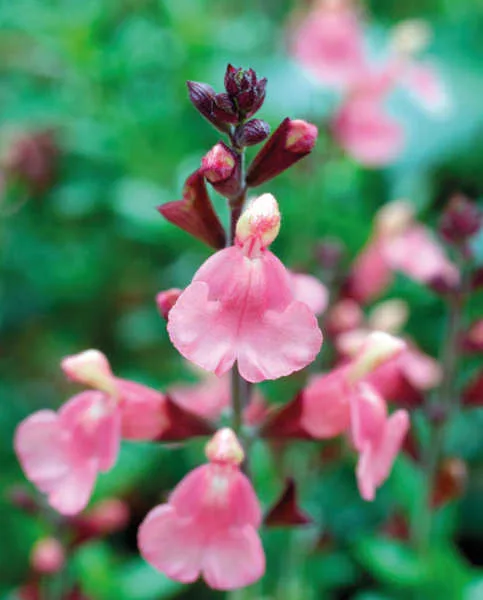
Scientific classification
- Species
- sage 'Señorita Leah' (Salvia × jamensis 'Señorita Leah')
- Genus
- Salvia
- Family
- Lamiaceae
- Order
- Lamiales
- Class
- Magnoliopsida
- Phylum
- Tracheophyta
- Information to be completed
- Toxicity
- Shrubs
- Plant type
- 0.5-1 metres
- Height
- 0.5-1 metres
- Spread
- Evergreen
- Foliage
- Bushy
- Habit
- Spring · Summer · Autumn · Winter
- Season of interest
- Full sun
- Sunlight
- Information to be completed
- Ideal temperature









sage 'Señorita Leah' pictures
Distribution of sage 'Señorita Leah'
Distribution map
- Native
- Introduced
- Cultivated
Source:WCVP v16 · Royal Botanic Gardens, Kew · CC BY 3.0 · Boundaries:WGSRPD / TDWG
sage 'Señorita Leah' care guide
- Deep water after soil dries halfway, light mist foliage on hot days
- Watering
- Full sun
- Sunlight

Watering
Deep water after soil dries halfway, light mist foliage on hot days
Fertilizing
 Fertilizing
Diluted flowering sage feed every three weeks spring through late summer
Pruning
 Pruning
Prune lightly as needed to remove unwanted shoots and keep the shrub in shape. Prune in spring. Remove spent flowers to extend flowering.
Propagation
 Propagation
Propagate by basal cuttings or softwood cuttings in spring or early summer or semi-hardwood cuttings in late summer or autumn with bottom heat
Growing
 Growing
Grow in light, moderately fertile, well-drained soil. Needs a sheltered position, but usually overwinters if given full sun and good drainage. Drought resistant and attractive to pollinating insects
Common pests and diseases
Diseases
May be susceptible to honey fungus (rarely), powdery mildews, verticillium wilt and foot and root rots
Pests
May be susceptible to sage leafhopper, slugs, snails and rosemary beetle
Explore the plant health library →




