
Petunia patagonica
Also known as: Information to be completed
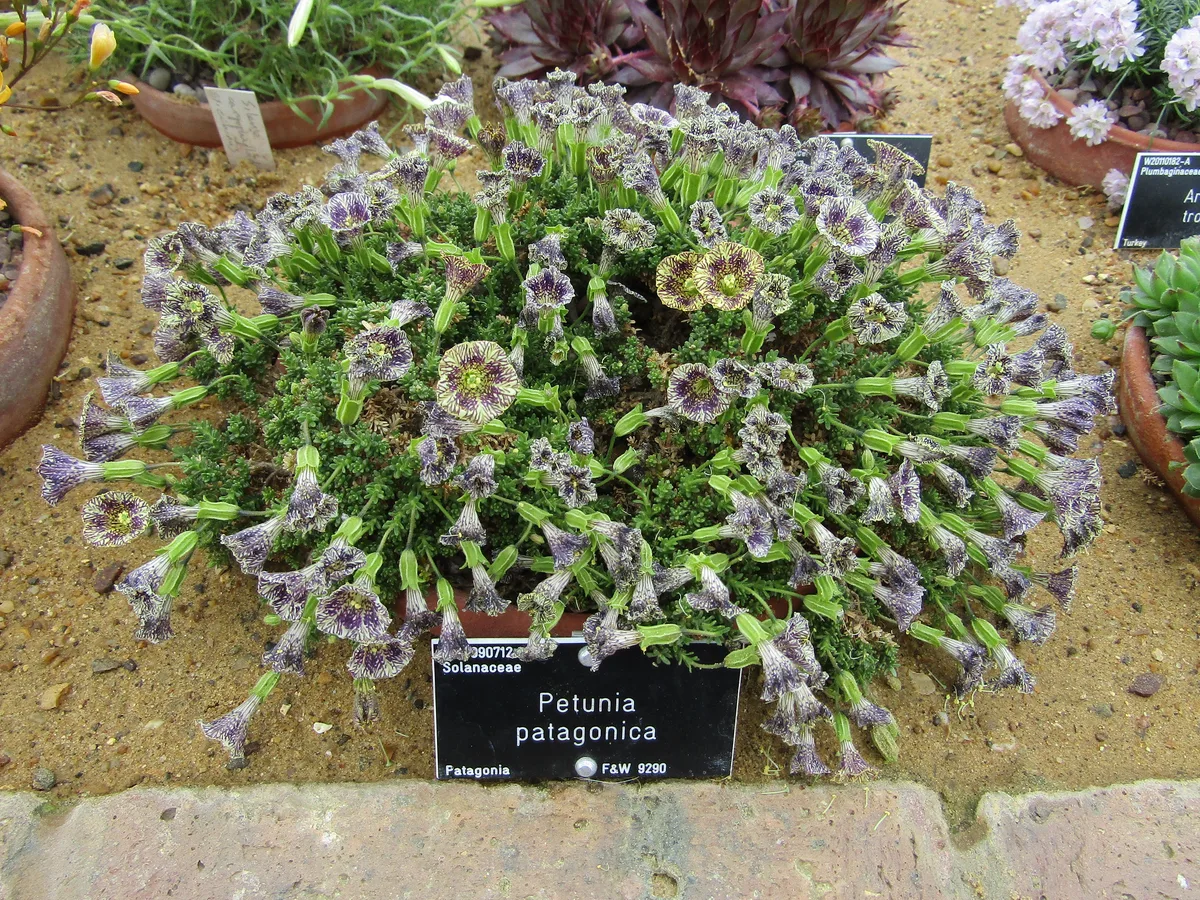
A rare and unusual, drought-tolerant, perennial, hardy alpine species with unusual flowers that are pale white to creamy yellow with purple-brown veining. Its unique flowers fade to give two different colour combinations of flowers on the same plant. It must have very free draining, quite poor soil in crevices / walls, between rocks in a scree garden or bed, or grow in pots and troughs. It can reach a height of approximately 8cm and a spread of 30cm. The leaves of the plant are tiny, quite succulent and mid-green in colour. The plant is gently spreading and almost cushion or Sedum-like in appearance.
Scientific classification
- Species
- Petunia patagonica (Petunia patagonica)
- Genus
- Petunia
- Family
- Solanaceae
- Order
- Solanales
- Class
- Magnoliopsida
- Phylum
- Magnoliophyta
- Information to be completed
- Toxicity
- Alpine Rockery
- Plant type
- Up to 10 cm
- Height
- 0.1-0.5 metres
- Spread
- Evergreen
- Foliage
- Matforming
- Habit
- Spring · Summer · Autumn · Winter
- Season of interest
- Full sun
- Sunlight
- Information to be completed
- Ideal temperature









Petunia patagonica pictures
Distribution of Petunia patagonica
Distribution map
- Native
- Introduced
- Cultivated
Source:WCVP v16 · Royal Botanic Gardens, Kew · CC BY 3.0 · Boundaries:WGSRPD / TDWG
Petunia patagonica care guide
- Keep compost lightly moist, never fully drying out while blooming
- Watering
- Full sun
- Sunlight

Watering
Keep compost lightly moist, never fully drying out while blooming
Fertilizing
 Fertilizing
Weak flowering feed every two to three weeks in active bloom
Pruning
 Pruning
No pruning required. Dead-head after flowering.
Propagation
 Propagation
Propagate by seed and softwood cuttings
Growing
 Growing
Grow in light, poor, well-drained soil in full sun. See alpine cultivation
Common pests and diseases
Diseases
May be subsceptible to grey moulds, foot rot and a virus
Pests
May be susceptible to aphids and slugs
Explore the plant health library →




