
Hesperantha coccinea 'Professor Barnard'
Also known as: Information to be completed
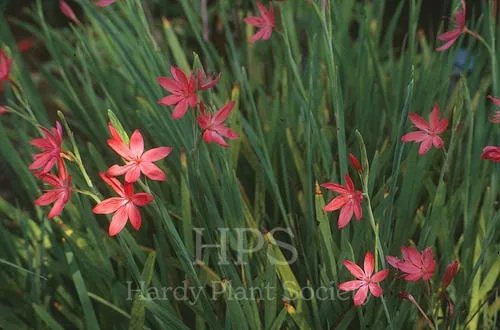
A vigorous, perennial that grows from thick rhizome roots. In autumn it produces pink, star-shaped flowers on thin stems above grass-like, semi-evergreen foliage.
Scientific classification
- Species
- Hesperantha coccinea 'Professor Barnard' (Hesperantha coccinea 'Professor Barnard')
- Genus
- Hesperantha
- Family
- Iridaceae
- Order
- Asparagales
- Class
- Liliopsida
- Phylum
- Magnoliophyta
- Information to be completed
- Toxicity
- Herbaceous Perennial
- Plant type
- 0.5-1 metres
- Height
- 0.1-0.5 metres
- Spread
- Semi evergreen
- Foliage
- Clump forming
- Habit
- Spring · Summer · Autumn · Winter
- Season of interest
- Full sun
- Sunlight
- Information to be completed
- Ideal temperature









Hesperantha coccinea 'Professor Barnard' pictures
Distribution of Hesperantha coccinea 'Professor Barnard'
Distribution map
- Native
- Introduced
- Cultivated
Source:WCVP v16 · Royal Botanic Gardens, Kew · CC BY 3.0 · Boundaries:WGSRPD / TDWG
Hesperantha coccinea 'Professor Barnard' care guide
- Moderate regular watering, avoid prolonged drought or waterlogging
- Watering
- Full sun
- Sunlight

Watering
Moderate regular watering, avoid prolonged drought or waterlogging
Fertilizing
 Fertilizing
Balanced feed in spring and light repeat in growth season
Pruning
 Pruning
No pruning required. Remove withered leaves and flower stems by hand.
Propagation
 Propagation
Propagate by seed at 13-16°C (55-61°F) in spring. Propagate by division in spring.
Growing
 Growing
Grow in moderately fertile, moist but well-drained soil in full sun.
Common pests and diseases
Diseases
Generally disease-free
Pests
Generally pest-free
Explore the plant health library →




