
sorbaria 'Sem'
Also known as: Information to be completed
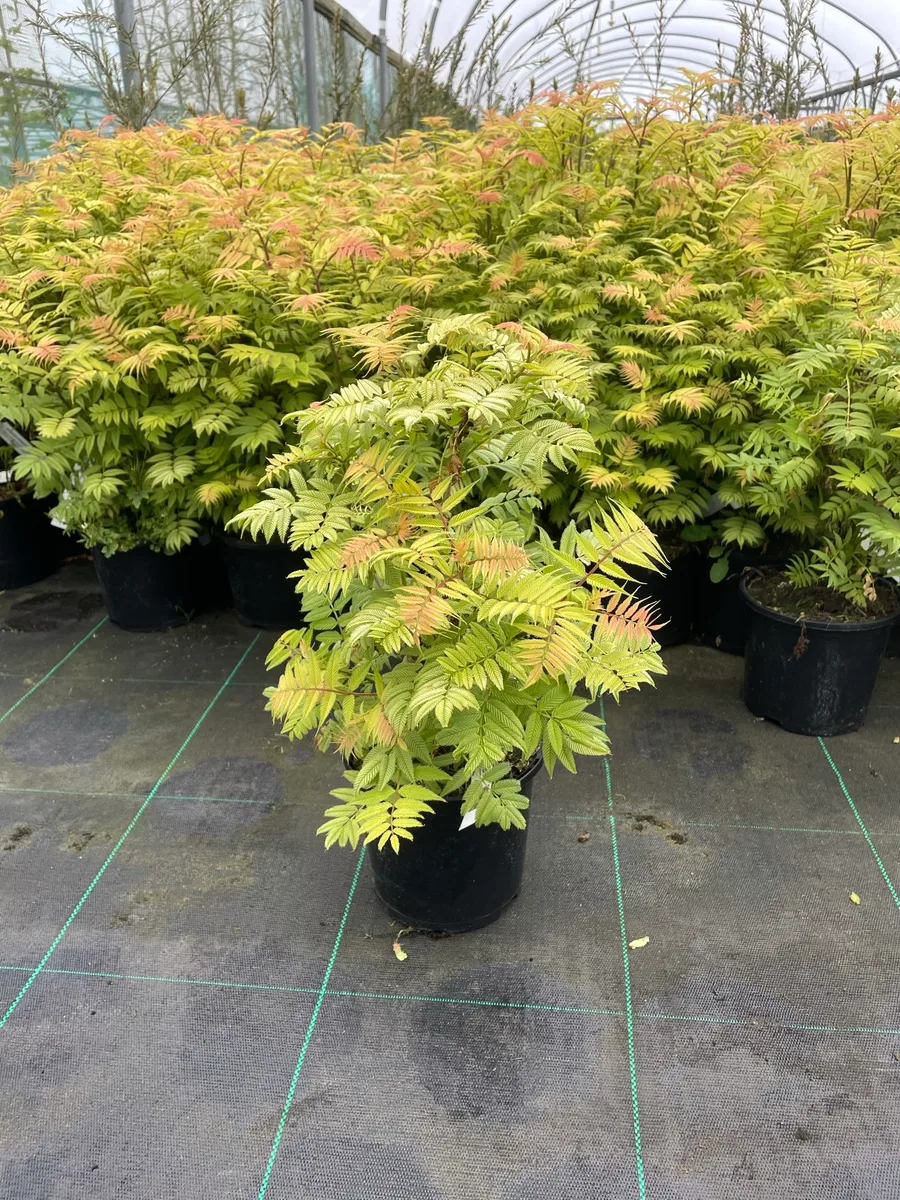
A small, compact selection, to 1.5m, of this thicket-forming shrub. It has many upright stems and a distinctive leaf colouring; yellow-green flushed with bright reddish-pink and bronze in spring. Leaves become greener in summer, but redden in autumn; colouring is best in good light. Flowers are borne in stiff, erect, rather narrow panicles of small white flowers in summer
Scientific classification
- Species
- sorbaria 'Sem' (Sorbaria sorbifolia 'Sem')
- Genus
- Sorbaria
- Family
- Rosaceae
- Order
- Rosales
- Class
- Magnoliopsida
- Phylum
- Magnoliophyta
- Information to be completed
- Toxicity
- Shrubs
- Plant type
- 1-1.5 metres
- Height
- 1-1.5 metres
- Spread
- Deciduous
- Foliage
- Suckering
- Habit
- Autumn · Spring · Summer
- Season of interest
- Full sun · Partial shade
- Sunlight
- Information to be completed
- Ideal temperature









sorbaria 'Sem' pictures
Distribution of sorbaria 'Sem'
Distribution map
- Native
- Introduced
- Cultivated
Source:WCVP v16 · Royal Botanic Gardens, Kew · CC BY 3.0 · Boundaries:WGSRPD / TDWG
sorbaria 'Sem' care guide
- Moderate regular watering, allowing brief slight drying between soakings
- Watering
- Full sun · Partial shade
- Sunlight

Watering
Moderate regular watering, allowing brief slight drying between soakings
Fertilizing
 Fertilizing
Balanced perennial feed every four weeks from spring through summer
Pruning
 Pruning
Cut flowered growth back to strong young shoots below, removing up to a fifth of old stems near the base each year. Prune immediately after flowering.
Propagation
 Propagation
Propagate by semi-hardwood cuttings in mid-summer or propagate by seed sown in containers in a coldframe in autumn. Rooted suckers can be transplanted in winter or autumn
Growing
 Growing
Best grown in moderately fertile, moist but well-drained soil. Useful for waterside plantings but neglected plants can rapidly form thickets. Has the potential to become a nuisance if not managed well
Common pests and diseases
Diseases
Generally disease free
Pests
Generally pest-free
Explore the plant health library →




