
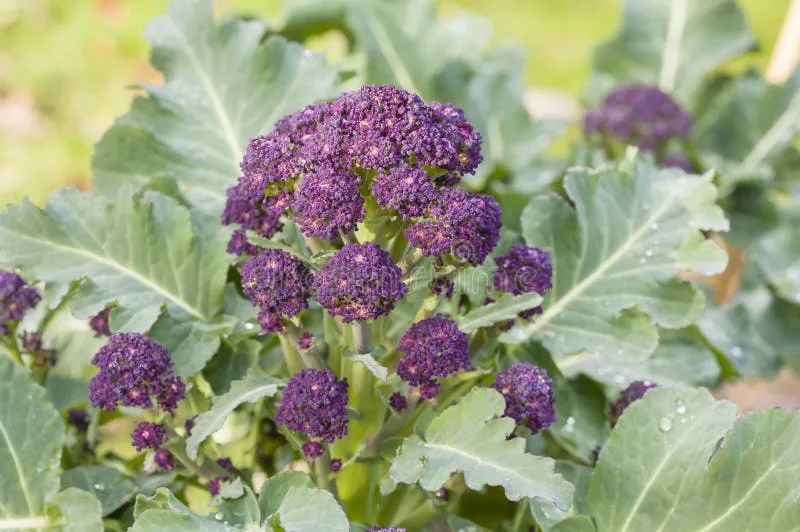
broccoli (purple sprouting) 'Rudolph'
Also known as: Information to be completed
A hardy biennial purple sprouting broccoli variety grown as an annual. It is one of the earliest varieties, producing well coloured, good sized purple spears from November to March when fresh vegetables in the garden tend to be scarce. If growing in colder climates, the crop will be ready to harvest from February
Scientific classification
- Species
- broccoli (purple sprouting) 'Rudolph' (Brassica oleracea 'Rudolph')
- Genus
- Brassica
- Family
- Brassicaceae
- Order
- Brassicales
- Class
- Magnoliopsida
- Phylum
- Tracheophyta
- Information to be completed
- Toxicity
- Annual Biennial
- Plant type
- 0.5-1 metres
- Height
- 0.5-1 metres
- Spread
- Deciduous
- Foliage
- Clump forming
- Habit
- Summer · Autumn · Winter
- Season of interest
- Full sun
- Sunlight
- Information to be completed
- Ideal temperature









broccoli (purple sprouting) 'Rudolph' pictures
Distribution of broccoli (purple sprouting) 'Rudolph'
Distribution map
- Native
- Introduced
- Cultivated
Source:WCVP v16 · Royal Botanic Gardens, Kew · CC BY 3.0 · Boundaries:WGSRPD / TDWG
broccoli (purple sprouting) 'Rudolph' care guide
- Even consistent moisture, drain excess water after each watering round
- Watering
- Full sun
- Sunlight

Watering
Even consistent moisture, drain excess water after each watering round
Fertilizing
 Fertilizing
Weak vegetable balanced feed biweekly spring growing period
Pruning
 Pruning
No pruning required
Propagation
 Propagation
Propagate by seed. See sowing vegetable seeds or sowing seeds indoors for further advice
Growing
 Growing
Grow in fertile, well compacted, non-acid soil in full sun. Sow seeds in Spring in shallow drills at 1.5cm depth, thin to 30cm apart when 10-15cm tall or have four or five leaves. See broccoli cultivation for more detailed advice
Common pests and diseases
Diseases
May be susceptible to black rot, clubroot, downy mildews, grey moulds, leaf spot, white blister
Pests
May be susceptible to birds, cabbage caterpillars, cabbage whitefly, cabbage root fly, cutworms, flea beetles, mealy cabbage aphid, slugs and snails
Explore the plant health library →




