
giant leopard plant
Also known as: Information to be completed
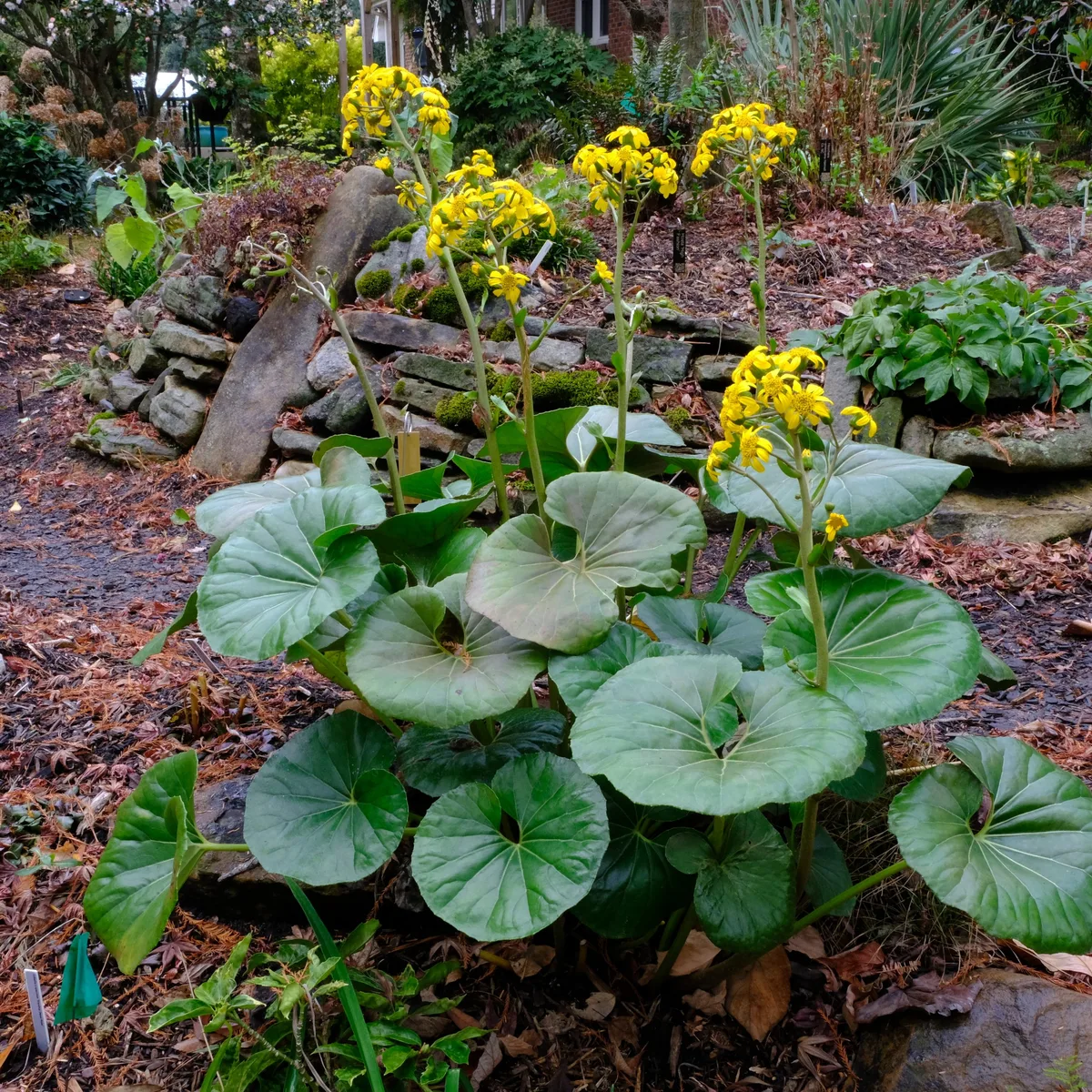
A clump-forming, evergreen perennial to 60cm tall, prized for its glossy foliage. The dark green, kidney-shaped leaves are held on long stalks and can reach more than 30cm across. Yellow, daisy-like flowers are produced in loose clusters in autumn and winter
Scientific classification
- Species
- giant leopard plant (Farfugium japonicum var. giganteum)
- Genus
- Farfugium
- Family
- Asteraceae
- Order
- Asterales
- Class
- Magnoliopsida
- Phylum
- Tracheophyta
- Information to be completed
- Toxicity
- Information to be completed
- Plant type
- 0.5-1 metres
- Height
- 0.5-1 metres
- Spread
- Evergreen
- Foliage
- Clump forming
- Habit
- Spring · Summer · Autumn · Winter
- Season of interest
- Partial shade
- Sunlight
- Information to be completed
- Ideal temperature









giant leopard plant pictures
Distribution of giant leopard plant
Distribution map
- Native
- Introduced
- Cultivated
Source:WCVP v16 · Royal Botanic Gardens, Kew · CC BY 3.0 · Boundaries:WGSRPD / TDWG
giant leopard plant care guide
- Moderate regular watering, allowing slight drying between waterings
- Watering
- Partial shade
- Sunlight

Watering
Moderate regular watering, allowing slight drying between waterings
Fertilizing
 Fertilizing
Balanced feed monthly during active growth season
Pruning
 Pruning
No pruning required. Trim off dead leaves in spring
Propagation
 Propagation
Propagate by seed sown in containers in a cold frame in winter or spring, or by division in spring
Growing
 Growing
Grow in moist but well-drained, fertile soil in partial shade; will tolerate more sun if the ground stays moist. Shelter from cold, drying winds. Provide a deep, dry winter mulch in cold areas.
Common pests and diseases
Diseases
Generally disease-free
Pests
May be susceptible to slugs
Explore the plant health library →




