
blemish-free cyclamen
Also known as: Information to be completed
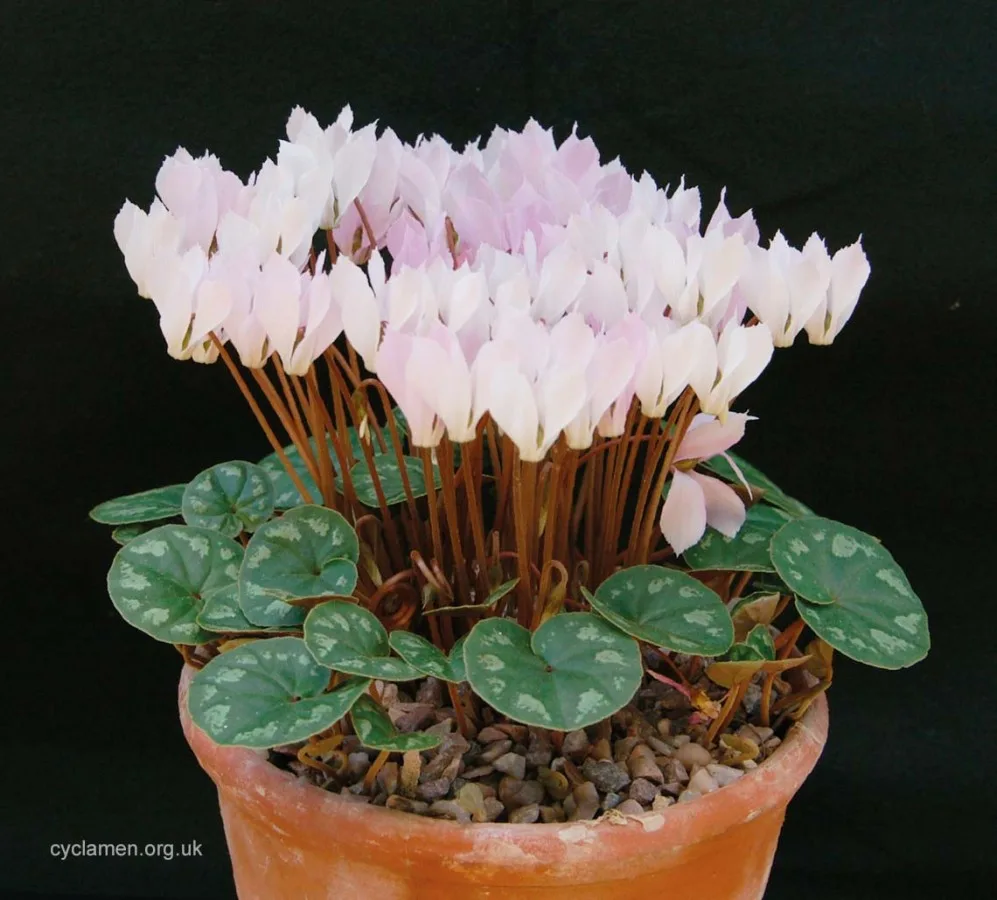
A small tuberous perennial, up to 10cm high, with rounded heart-shaped marbled green leaves, light green beneath, about 4cm across. Unscented flowers, 1cm across, white or pale pink with silver-grey veins, appear from autumn to early winter
Scientific classification
- Species
- blemish-free cyclamen (Cyclamen intaminatum)
- Genus
- Cyclamen
- Family
- Primulaceae
- Order
- Ericales
- Class
- Magnoliopsida
- Phylum
- Magnoliophyta
- Ornamental bulbs, not to be eaten. Wear gloves and other protective equipment when handling
- Toxicity
- Alpine Rockery · Conservatory Greenhouse · Herbaceous Perennial
- Plant type
- Up to 10 cm
- Height
- 0-0.1 metre
- Spread
- Deciduous
- Foliage
- Bushy
- Habit
- Spring · Autumn · Winter
- Season of interest
- Partial shade
- Sunlight
- Information to be completed
- Ideal temperature









blemish-free cyclamen pictures
Distribution of blemish-free cyclamen
Distribution map
- Native
- Introduced
- Cultivated
Source:WCVP v16 · Royal Botanic Gardens, Kew · CC BY 3.0 · Boundaries:WGSRPD / TDWG
Toxicity
Ornamental bulbs, not to be eaten. Wear gloves and other protective equipment when handling
blemish-free cyclamen care guide
- Moderate regular watering, allowing brief slight drying between soakings
- Watering
- Partial shade
- Sunlight

Watering
Moderate regular watering, allowing brief slight drying between soakings
Fertilizing
 Fertilizing
Balanced perennial feed every four weeks from spring through summer
Pruning
 Pruning
No pruning required
Propagation
 Propagation
Propagate by seed (as for hardy cyclamen) as soon as it is ripe when the seed capsule splits in summer
Growing
 Growing
Plant so that the tops of the tubers are either at or just below the surface, in humus-rich, well-drained soil, in partial shade from deciduous trees or shrubs which will keep the tubers dry during their summer dormancy; when the leaves die back in spring, mulch with leafmould; may also be grown in pots or pans in an alpine house or frame
Common pests and diseases
Diseases
May be susceptible to cyclamen grey mould and damping-off of seedlings
Pests
May be susceptible to mice or grey squirrels digging up the tubers
Explore the plant health library →




