
white Azorean jasmine
Also known as: Information to be completed
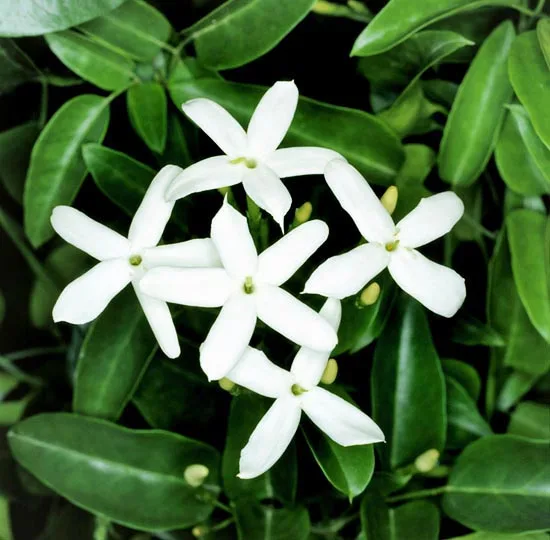
J. azoricum is a twining or scrambling evergreen shrub to 3m or more, with dark green leaves composed of three wavy-edged, ovate leaflets, and fragrant white flowers 2.5cm across, in terminal panicles

Scientific classification
- Species
- white Azorean jasmine (Jasminum azoricum)
- Genus
- Jasminum
- Family
- Oleaceae
- Order
- Lamiales
- Class
- Magnoliopsida
- Phylum
- Magnoliophyta
- Information to be completed
- Toxicity
- Climber Wall Shrub · Shrubs · Conservatory Greenhouse
- Plant type
- 2.5-4 metres
- Height
- 0.5-1 metres
- Spread
- Evergreen
- Foliage
- Climbing
- Habit
- Spring · Summer · Autumn · Winter
- Season of interest
- Full sun
- Sunlight
- Information to be completed
- Ideal temperature









white Azorean jasmine pictures




Distribution of white Azorean jasmine
Distribution map
- Native
- Introduced
- Cultivated
Source:WCVP v16 · Royal Botanic Gardens, Kew · CC BY 3.0 · Boundaries:WGSRPD / TDWG
white Azorean jasmine care guide
- Moderate regular watering, avoid prolonged drought and stagnant waterlogging
- Watering
- Full sun
- Sunlight

Watering
Moderate regular watering, avoid prolonged drought and stagnant waterlogging
Fertilizing
 Fertilizing
Balanced perennial feed every four weeks spring through summer growth
Pruning
 Pruning
Train using the following detail: climbers: training and pruning on planting and once a twining habit is established, pruning is less frequent. Minimal pruning will leave plants looking attractive but some thinning will be needed from time to time, after flowering, to prevent accumulation of weak and older stems. Plants will usually respond to fairly hard cutting back in late winter, but may be slow to recover
Propagation
 Propagation
Take greenwood cuttings of soft, young growths, taken in early spring and rooted under mist or in two parts sharp sand to one part peat substitute with bottom heat at 16C (61F)
Growing
 Growing
Tender, so suits a conservatory or cool greenhouse. Grow in a loam-based compost such as John Innes No 2 in bright filtered light or full light with shade from hot sun. Apply a potassium rich fertiliser such as tomato feed monthly in the growing season. Water less frequently in winter
Common pests and diseases
Diseases
May be susceptible to honey fungus (rarely)
Pests
May be susceptible to aphids, scale insects and mealybugs and glasshouse red spider mite under glass
Explore the plant health library →




