
Corydalis curviflora subsp. rosthornii 'Blue Heron'
Also known as: Information to be completed
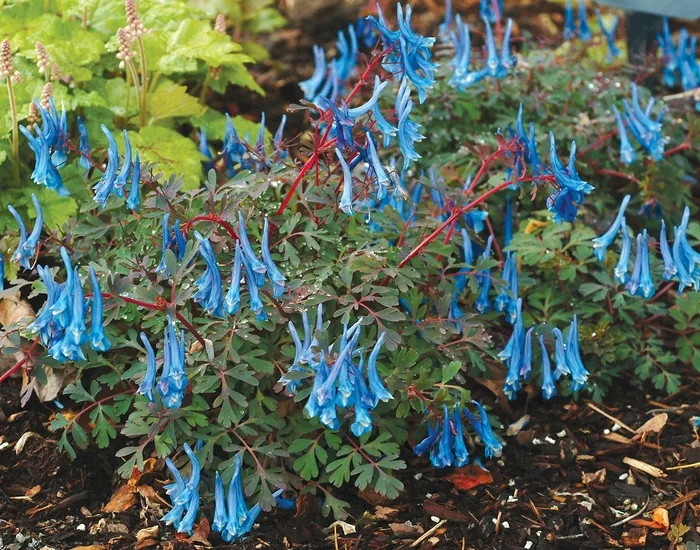
A compact, evergreen perennial forming a mound of finely-divided grey-green leaves and bearing fragrant, blue, tubular flowers clustered on upright red stems from late spring into early summer
Scientific classification
- Species
- Corydalis curviflora subsp. rosthornii 'Blue Heron' (Corydalis curviflora subsp. rosthornii 'Blue Heron')
- Genus
- Corydalis
- Family
- Papaveraceae
- Order
- Ranunculales
- Class
- Magnoliopsida
- Phylum
- Tracheophyta
- Information to be completed
- Toxicity
- Herbaceous Perennial
- Plant type
- 0.1-0.5 metres
- Height
- 0.1-0.5 metres
- Spread
- Evergreen
- Foliage
- Clump forming
- Habit
- Spring · Summer · Autumn · Winter
- Season of interest
- Partial shade
- Sunlight
- Information to be completed
- Ideal temperature









Corydalis curviflora subsp. rosthornii 'Blue Heron' pictures
Distribution of Corydalis curviflora subsp. rosthornii 'Blue Heron'
Distribution map
- Native
- Introduced
- Cultivated
Source:WCVP v16 · Royal Botanic Gardens, Kew · CC BY 3.0 · Boundaries:WGSRPD / TDWG
Corydalis curviflora subsp. rosthornii 'Blue Heron' care guide
- Cool lightly damp soil conditions required, avoid hot dry exposure
- Watering
- Partial shade
- Sunlight

Watering
Cool lightly damp soil conditions required, avoid hot dry exposure
Fertilizing
 Fertilizing
Weak woodland perennial feed monthly spring through summer months
Pruning
 Pruning
No pruning required
Propagation
 Propagation
Propagate by division
Growing
 Growing
Grow in moderately fertile, moist but well-drained, humus-rich soil in partial shade
Common pests and diseases
Diseases
Generally disease-free
Pests
Generally pest-free but slugs and snails may damage young growth
Explore the plant health library →




