
coneflower [Pixie Meadowbrite]
Also known as: Information to be completed
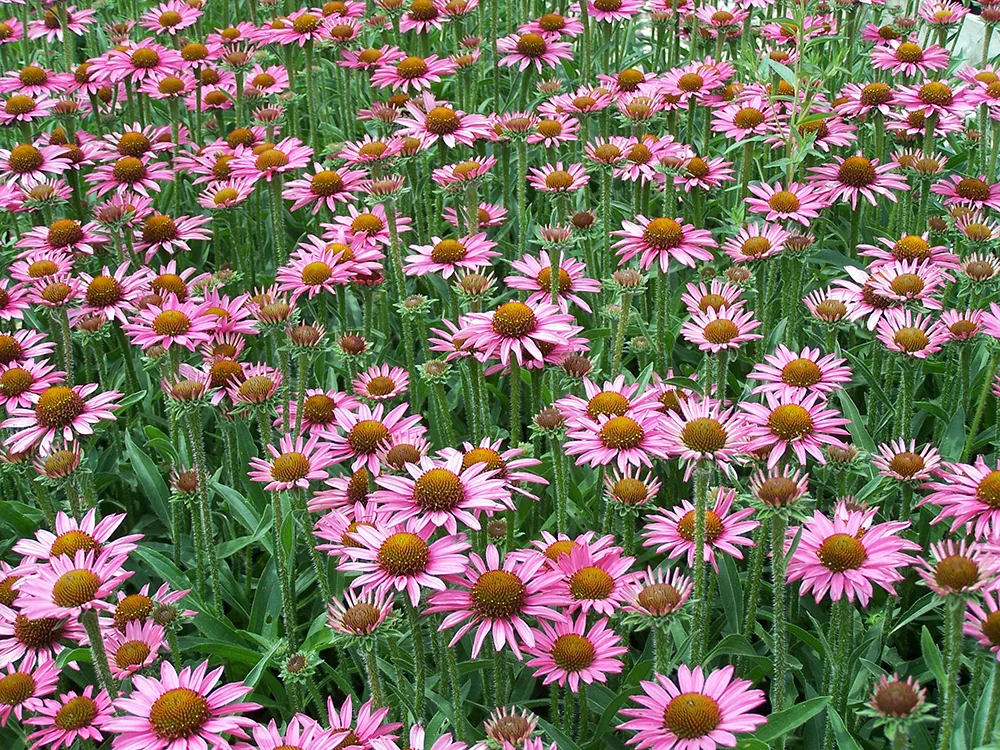
A dwarf, upright, perennial coneflower variety producing a profusion of mildly fragrant, bright pink blooms from early to late Summer. Flowers have a large, prominent, central copper-orange cone surrounded by flat pink ray florets, held on well branched and sturdy stems. Extremely attractive to pollinators and excellent as a cut flower
Scientific classification
- Species
- coneflower [Pixie Meadowbrite] (Echinacea Pixie Meadowbrite ('CBG Cone 2'))
- Genus
- Echinacea
- Family
- Asteraceae
- Information to be completed
- Toxicity
- Herbaceous Perennial
- Plant type
- 0.5-1 metres
- Height
- 0.5-1 metres
- Spread
- Deciduous
- Foliage
- Clump forming
- Habit
- Spring · Summer · Autumn
- Season of interest
- Full sun
- Sunlight
- Information to be completed
- Ideal temperature









coneflower [Pixie Meadowbrite] pictures
Distribution of coneflower [Pixie Meadowbrite]
Distribution map
Information to be completed
Information to be completed
Culture
Information to be completed
Toxicity
Information to be completed
Quick identification of coneflower [Pixie Meadowbrite]
Information to be completed
coneflower [Pixie Meadowbrite] care guide
- Water deeply after partial soil dry, good drainage prevents rot roots
- Watering
- Full sun
- Sunlight
- Information to be completed
- Ideal temperature

Watering
Water deeply after partial soil dry, good drainage prevents rot roots
Fertilizing
 Fertilizing
Balanced coneflower feed every three weeks spring through mid fall
Pruning
 Pruning
Deadhead to extend flowering
Propagation
 Propagation
Propagate by division in Spring or Autumn or by root cuttings from late Autumn to early Winter
Growing
 Growing
Grow in fertile, humus rich, well drained soil in full sun. Take care when propagating by divison or root cuttings as they resent a lot of disturbance
People also ask
Information to be completed
Common pests and diseases
Diseases
Generally disease-free
Pests
Generally pest-free
Explore the plant health library →




