
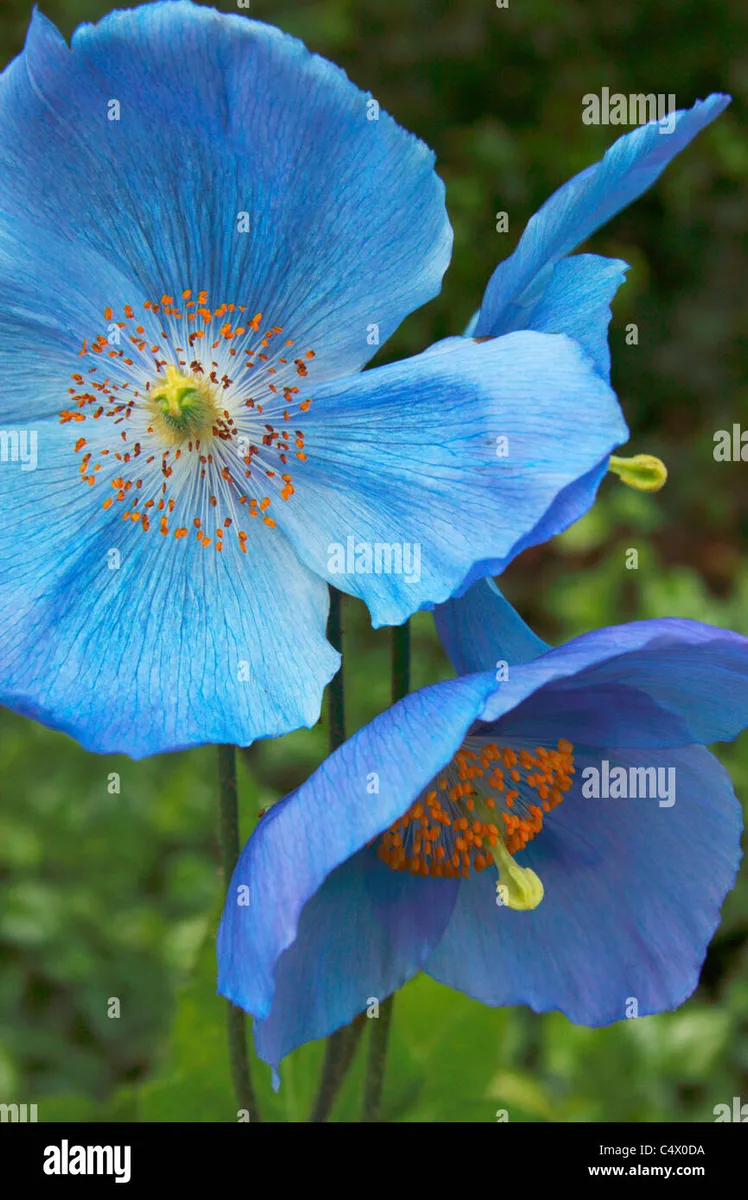
Himalayan blue poppy 'Dalemain'
Also known as: Information to be completed
Dalemain' is a short-lived perennial about 1m tall, forming an upright rosette of long, oval, hairy leaves suffused with red-purple when young. In summer, erect, leafy stems bear a cluster of deep blue poppies, sometimes suffused with mauve or purple tones with contrasting yellow stamens. The seed capsules, covered in bristly hairs, are decorative but contain no viable seed
Scientific classification
- Species
- Himalayan blue poppy 'Dalemain' (Meconopsis 'Dalemain')
- Genus
- Meconopsis
- Family
- Papaveraceae
- Information to be completed
- Toxicity
- Herbaceous Perennial
- Plant type
- 0.5-1 metres
- Height
- 0.1-0.5 metres
- Spread
- Deciduous
- Foliage
- Columnar upright
- Habit
- Spring · Summer · Autumn
- Season of interest
- Partial shade
- Sunlight
- Information to be completed
- Ideal temperature









Himalayan blue poppy 'Dalemain' pictures
Distribution of Himalayan blue poppy 'Dalemain'
Distribution map
Information to be completed
Information to be completed
Culture
Information to be completed
Toxicity
Information to be completed
Quick identification of Himalayan blue poppy 'Dalemain'
Information to be completed
Himalayan blue poppy 'Dalemain' care guide
- Moderate regular watering, allowing brief slight drying between soakings
- Watering
- Partial shade
- Sunlight
- Information to be completed
- Ideal temperature

Watering
Moderate regular watering, allowing brief slight drying between soakings
Fertilizing
 Fertilizing
Balanced perennial feed every four weeks from spring through summer
Pruning
 Pruning
Cut down to the base in late autumn
Propagation
 Propagation
Propagate by division after flowering, but can be short lived
Growing
 Growing
Only suitable for particular sites: the soil needs to be neutral to slightly acid, moist but well-drained and enriched with leaf mould or humus to prevent stagnation; in a partially shaded site with shelter from cold, dry winds. Thrives in areas with cool damp summers
People also ask
Information to be completed
Common pests and diseases
Diseases
May be affected by a downy mildew
Pests
May be attacked by slugs and snails
Explore the plant health library →




