
Paeonia lactiflora 'Cora Stubbs'
Also known as: Information to be completed
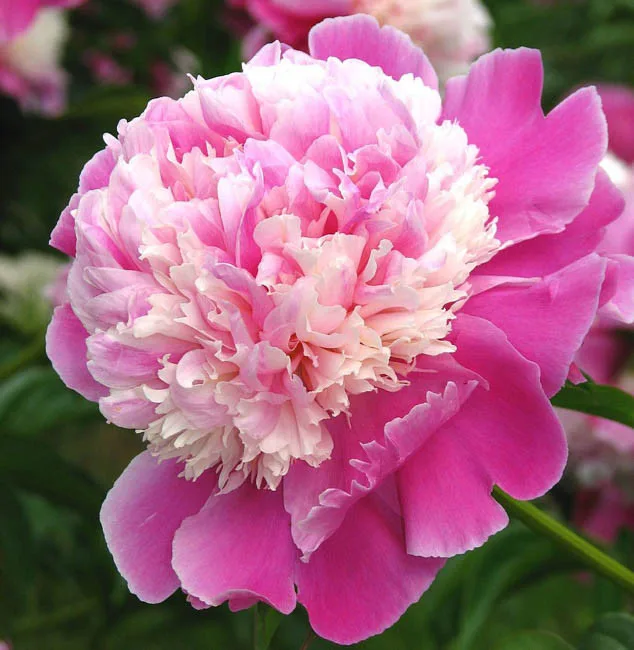
An upright and bushy herbaceous perennial with attractive, dissected dark green foliage tinged red in spring. Erect stems holding showy, spicily scented, semi-double, saucer-shaped raspberry pink flowers with a tufted centre of creamy pink petaloids appear in summer.
Scientific classification
- Species
- Paeonia lactiflora 'Cora Stubbs' (Paeonia lactiflora 'Cora Stubbs')
- Genus
- Paeonia
- Family
- Paeoniaceae
- Order
- Saxifragales
- Class
- Magnoliopsida
- Phylum
- Magnoliophyta
- Information to be completed
- Toxicity
- Herbaceous Perennial
- Plant type
- 0.5-1 metres
- Height
- 0.5-1 metres
- Spread
- Deciduous
- Foliage
- Clump forming
- Habit
- Spring · Summer · Autumn
- Season of interest
- Full sun · Partial shade
- Sunlight
- Information to be completed
- Ideal temperature









Paeonia lactiflora 'Cora Stubbs' pictures
Distribution of Paeonia lactiflora 'Cora Stubbs'
Distribution map
- Native
- Introduced
- Cultivated
Source:WCVP v16 · Royal Botanic Gardens, Kew · CC BY 3.0 · Boundaries:WGSRPD / TDWG
Paeonia lactiflora 'Cora Stubbs' care guide
- Deep moderate watering, avoid wet crowns in winter
- Watering
- Full sun · Partial shade
- Sunlight

Watering
Deep moderate watering, avoid wet crowns in winter
Fertilizing
 Fertilizing
Feed in spring and lightly after flowering
Pruning
 Pruning
Remove spent flowers and cut back foliage in autumn when it dies back
Propagation
 Propagation
Propagate by division in autumn and early spring
Growing
 Growing
Will grow well in fertile, humus-rich, moist but well-drained soil in full sun or partial shade in a sheltered position. See herbaceous peony cultivation for more details.
Common pests and diseases
Diseases
May be susceptible to a virus, honey fungus, Verticillium wilt, peony leaf blotch and peony wilt
Pests
May be susceptible to leaf and bud eelworm and soil-dwelling swift moth caterpillar
Explore the plant health library →




