
Japanese barberry 'Royal Burgundy'
Also known as: Information to be completed
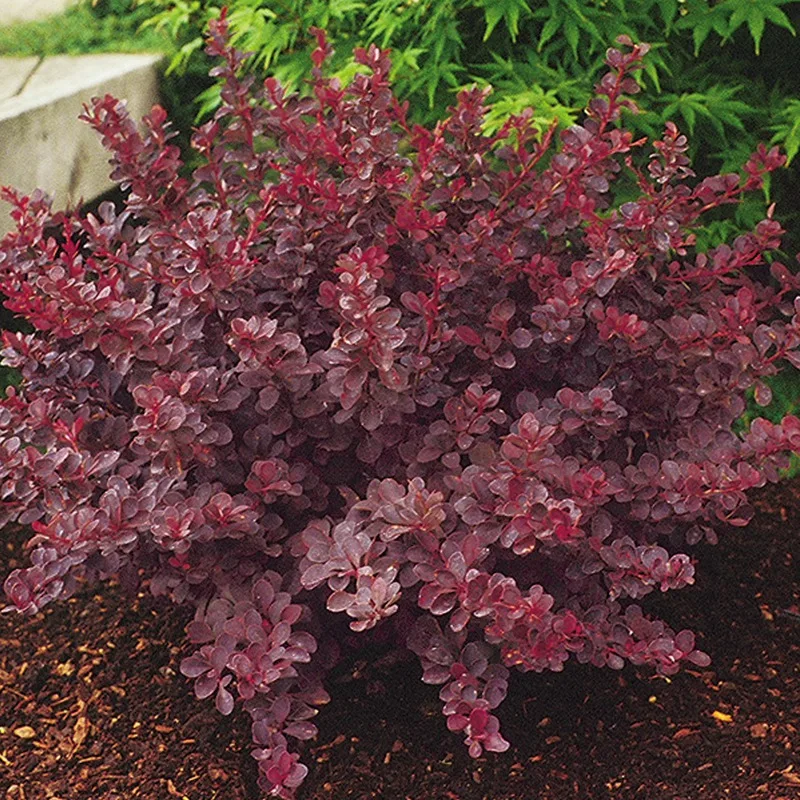
A low-growing, compact, dense deciduous shrub with oval-shaped, dark red foliage emerging in spring turning to a darker reddish-black. Small yellow flowers appear in the spring, followed by red berries in the autumn which may persist into winter
Scientific classification
- Species
- Japanese barberry 'Royal Burgundy' (Berberis thunbergii 'Royal Burgundy')
- Genus
- Berberis
- Family
- Berberidaceae
- Order
- Ranunculales
- Class
- Magnoliopsida
- Phylum
- Magnoliophyta
- Fruit are ornamental - not to be eaten. Wear gloves and other protective equipment when handling
- Toxicity
- Shrubs
- Plant type
- 0.5-1 metres
- Height
- 0.5-1 metres
- Spread
- Deciduous
- Foliage
- Bushy · Columnar upright
- Habit
- Spring · Summer · Autumn · Winter
- Season of interest
- Full sun
- Sunlight
- Information to be completed
- Ideal temperature









Japanese barberry 'Royal Burgundy' pictures
Distribution of Japanese barberry 'Royal Burgundy'
Distribution map
- Native
- Introduced
- Cultivated
Source:WCVP v16 · Royal Botanic Gardens, Kew · CC BY 3.0 · Boundaries:WGSRPD / TDWG
Toxicity
Fruit are ornamental - not to be eaten. Wear gloves and other protective equipment when handling
Japanese barberry 'Royal Burgundy' care guide
- Deep watering during dry spells, allowing slight surface drying between soakings
- Watering
- Full sun
- Sunlight

Watering
Deep watering during dry spells, allowing slight surface drying between soakings
Fertilizing
 Fertilizing
Balanced shrub or tree feed once each early spring
Pruning
 Pruning
Trim to shape after flowering or, for best foliage effect, cut back hard in spring
Propagation
 Propagation
Propagate by semi-hardwood cuttings
Growing
 Growing
Grows in any well-drained soil. Tolerates partial shade, but colour is best in full sun
Common pests and diseases
Diseases
May be susceptible to powdery mildews
Pests
May be susceptible to aphids and berberis sawfly
Explore the plant health library →




