
allium 'Mount Everest'
Also known as: Information to be completed
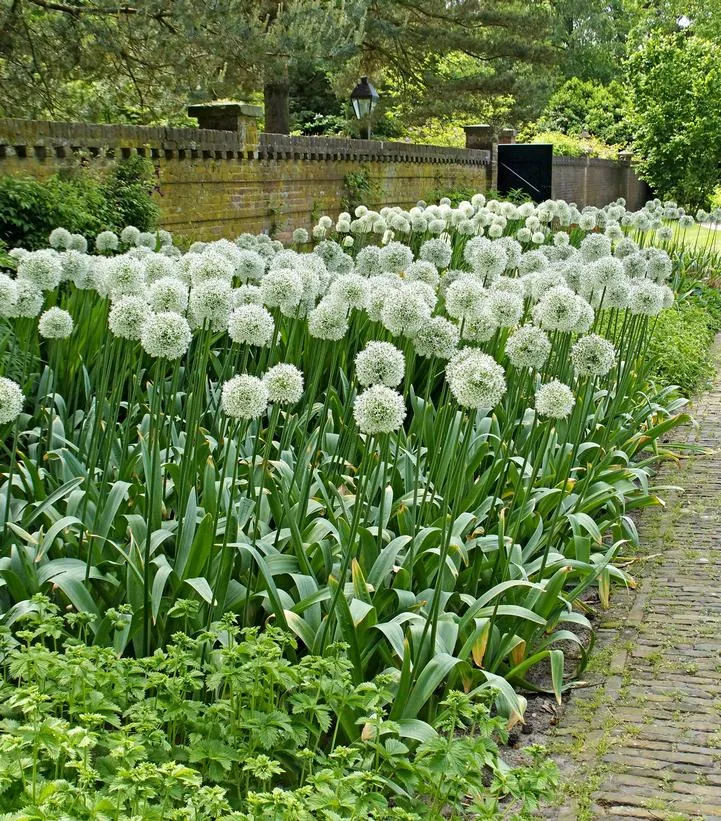
Mount Everest' is a hardy perennial bulb, up to 1.2m tall, with grey-green, strap-shaped leaves. Fifty or more white, star-shaped flowers form tightly-packed balls, up to 12cm across, held on tall, ribbed stems in late spring and early summer
Scientific classification
- Species
- allium 'Mount Everest' (Allium stipitatum 'Mount Everest')
- Genus
- Allium
- Family
- Amaryllidaceae
- Order
- Asparagales
- Class
- Liliopsida
- Phylum
- Magnoliophyta
- Information to be completed
- Toxicity
- Bulbs
- Plant type
- 1-1.5 metres
- Height
- 0.1-0.5 metres
- Spread
- Deciduous
- Foliage
- Columnar upright
- Habit
- Spring · Summer
- Season of interest
- Full sun
- Sunlight
- Information to be completed
- Ideal temperature









allium 'Mount Everest' pictures
Distribution of allium 'Mount Everest'
Distribution map
- Native
- Introduced
- Cultivated
Source:WCVP v16 · Royal Botanic Gardens, Kew · CC BY 3.0 · Boundaries:WGSRPD / TDWG
allium 'Mount Everest' care guide
- Moist soil during active growth, then reduce watering after foliage yellows
- Watering
- Full sun
- Sunlight

Watering
Moist soil during active growth, then reduce watering after foliage yellows
Fertilizing
 Fertilizing
Light bulb fertilizer at emergence and again after flowering
Pruning
 Pruning
No pruning required
Propagation
 Propagation
Propagate by removing offsets in autumn
Growing
 Growing
Easy to grow in fertile well-drained soil. Add grit when grown in clay soils to improve drainage. See allium cultivation
Common pests and diseases
Diseases
Onion white rot and a downy mildew may occur
Pests
Generally pest-free
Explore the plant health library →




