
red-leaved African milk tree
Also known as: Information to be completed
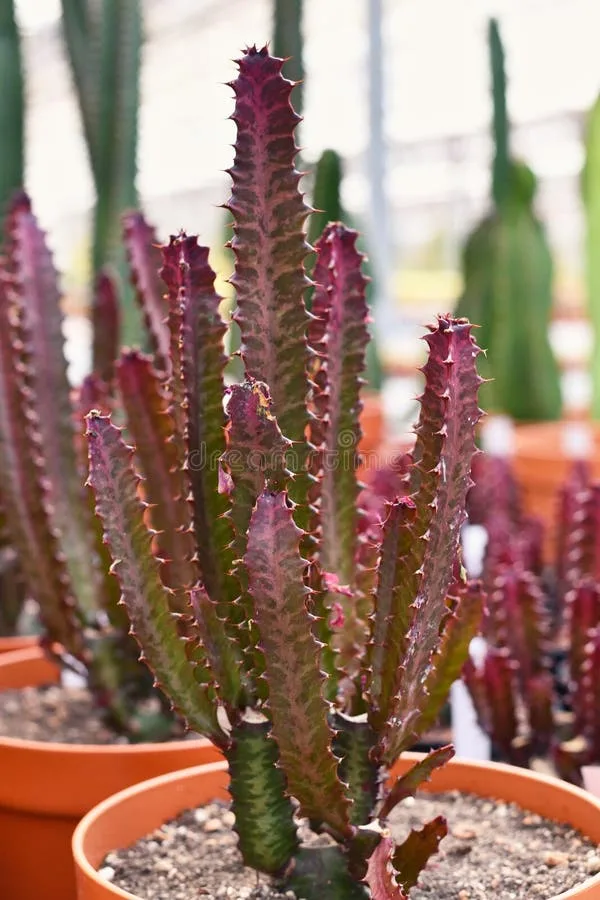
A tender, slow-growing, architectural succulent shrub producing very upright stems and branches to 1.8m (6ft) high. These are reddish-green and three to four sided, with short-lived, oval, reddish-purple leaves and persistent reddish-brown spines produced along the ridges of the stems. Along each side of the stems are variable, V-shaped bands in pale green. Small, insignificant, pale-green flowers can be produced in spring and summer at the tops of the stems, but these are unlikely to be produced on plants when grown in the home.
Scientific classification
- Species
- red-leaved African milk tree (Euphorbia trigona f. rubra)
- Genus
- Euphorbia
- Family
- Euphorbiaceae
- Order
- Malpighiales
- Class
- Magnoliopsida
- Phylum
- Magnoliophyta
- IRRITANT to skin/eye, harmful if eaten. Wear gloves and other protective equipment when handling]
- Toxicity
- Cactus Succulent
- Plant type
- 2.5-4 metres
- Height
- 0.5-1 metres
- Spread
- Evergreen
- Foliage
- Columnar upright
- Habit
- Spring · Summer · Autumn · Winter
- Season of interest
- Full sun · Partial shade
- Sunlight
- Information to be completed
- Ideal temperature









red-leaved African milk tree pictures
Toxicity
IRRITANT to skin/eye, harmful if eaten. Wear gloves and other protective equipment when handling]
red-leaved African milk tree care guide
- Moderate regular watering, allowing brief slight drying between soakings
- Watering
- Full sun · Partial shade
- Sunlight

Watering
Moderate regular watering, allowing brief slight drying between soakings
Fertilizing
 Fertilizing
Balanced perennial feed every four weeks from spring through summer
Pruning
 Pruning
Prune when necessary to reduce size in early spring
Propagation
 Propagation
Propagate by cuttings in spring or early summer; dip cut surfaces in charcoal or lukewarm water to prevent bleeding
Growing
 Growing
Grows best in well-drained soil, in full sun to partial shade. See Euphorbia for further advice
Common pests and diseases
Diseases
Generally disease-free
Pests
May be susceptible to mealybugs
Explore the plant health library →




