
purple coneflower 'Little Magnus'
Also known as: Information to be completed
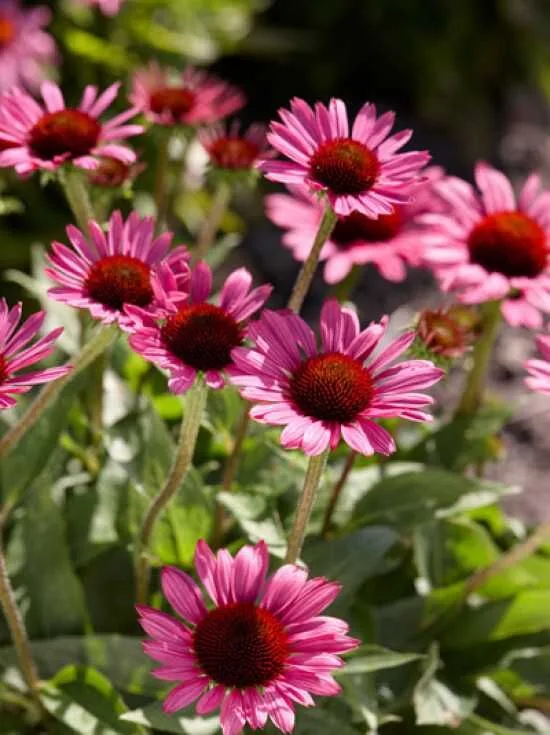
Compact perennial coneflower, reaching just 45cm high, with toothed, dark green leaves. Daisy-like flowers are made up of large, pink, horizontal ray-florets surrounding the dark orange-brown cones, in summer and autumn
Scientific classification
- Species
- purple coneflower 'Little Magnus' (Echinacea purpurea 'Little Magnus')
- Genus
- Echinacea
- Family
- Asteraceae
- Order
- Asterales
- Class
- Magnoliopsida
- Phylum
- Magnoliophyta
- Information to be completed
- Toxicity
- Herbaceous Perennial
- Plant type
- 0.1-0.5 metres
- Height
- 0.1-0.5 metres
- Spread
- Deciduous
- Foliage
- Clump forming
- Habit
- Spring · Summer · Autumn
- Season of interest
- Full sun · Partial shade
- Sunlight
- Information to be completed
- Ideal temperature









purple coneflower 'Little Magnus' pictures
Distribution of purple coneflower 'Little Magnus'
Distribution map
- Native
- Introduced
- Cultivated
Source:WCVP v16 · Royal Botanic Gardens, Kew · CC BY 3.0 · Boundaries:WGSRPD / TDWG
purple coneflower 'Little Magnus' care guide
- Moderate watering, allow some drying between irrigations
- Watering
- Full sun · Partial shade
- Sunlight

Watering
Moderate watering, allow some drying between irrigations
Fertilizing
 Fertilizing
Light balanced feed in spring, avoid overfeeding
Pruning
 Pruning
Cut back stems as the blooms fade to encourage further flower production
Propagation
 Propagation
Propagate by division in spring or autumn although they resent a lot of disturbance. Propagate by root cuttings from late autumn to early winter
Growing
 Growing
Grow in deep, well-drained, humus-rich soil ideally in full sun although they can tolerate some shade
Common pests and diseases
Diseases
Generally disease-free
Pests
Generally pest-free
Explore the plant health library →




