
Amelanchier alnifolia 'Smokey'
Also known as: Information to be completed
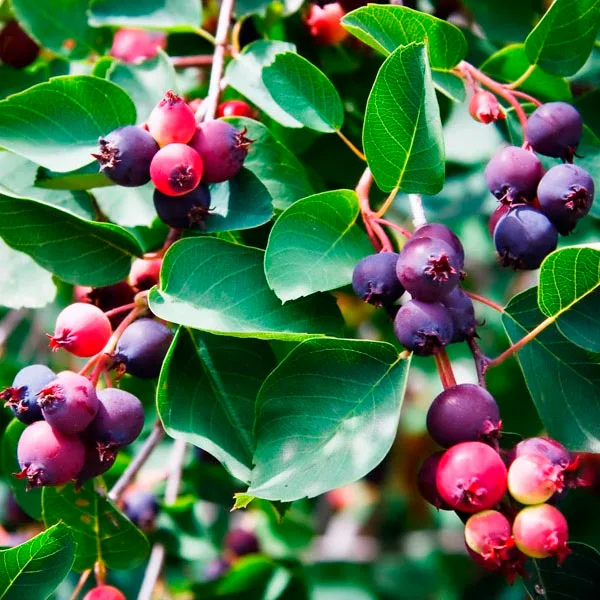
A medium to large bushy, suckering, deciduous upright shrub or small branching multi-stemmed tree, this cultivar is grown primarily for its impressive display of large, edible and sweet, smokey blue-black fruit. Bronze-tinged young leaves that are oval or circular in shape turn mid-to dark-green in summer, and then orange, red and pink-purple in autumn. Clusters of self-fertile five-petalled white flowers emerge in spring about 2-3cm across as the young leaves unfurl and expand. The fruits are enjoyed by wildlife
Scientific classification
- Species
- Amelanchier alnifolia 'Smokey' (Amelanchier alnifolia 'Smokey')
- Genus
- Amelanchier
- Family
- Rosaceae
- Order
- Rosales
- Class
- Magnoliopsida
- Phylum
- Magnoliophyta
- Fruit are ornamental - not to be eaten. Wear gloves and other protective equipment when handling
- Toxicity
- Shrubs · Trees
- Plant type
- 2.5-4 metres
- Height
- 2.5-4 metres
- Spread
- Deciduous
- Foliage
- Suckering · Columnar upright
- Habit
- Autumn · Spring · Summer · Winter
- Season of interest
- Full sun · Partial shade
- Sunlight
- Information to be completed
- Ideal temperature









Amelanchier alnifolia 'Smokey' pictures
Distribution of Amelanchier alnifolia 'Smokey'
Distribution map
- Native
- Introduced
- Cultivated
Source:WCVP v16 · Royal Botanic Gardens, Kew · CC BY 3.0 · Boundaries:WGSRPD / TDWG
Toxicity
Fruit are ornamental - not to be eaten. Wear gloves and other protective equipment when handling
Amelanchier alnifolia 'Smokey' care guide
- Moderate regular watering, deep soak only during prolonged hot spells
- Watering
- Full sun · Partial shade
- Sunlight

Watering
Moderate regular watering, deep soak only during prolonged hot spells
Fertilizing
 Fertilizing
Balanced evergreen shrub feed applied once per early spring yearly
Pruning
 Pruning
Little pruning is needed. Remove diseased, damaged, crowded or crossing shoots and unwanted growth. Timing depends on the plant: generally late winter or early spring; plants prone to bleeding and deciduous magnolias need different timing, and deciduous azaleas and lilacs are pruned after flowering.
Propagation
 Propagation
Propagate by softwood cuttings or semi-ripe cuttings in summer or layering.
Growing
 Growing
Grow in moist, lime-free, well-drained soil in sun or part shade. The best autumn colour is achieved when grown in full sun. Fruits are enjoyed by birds.
Common pests and diseases
Diseases
May be susceptible to fireblight. In dry soil conditions or strong winds, may be susceptible to leaf scorch.
Pests
Generally pest-free
Explore the plant health library →




