
Pseudowintera colorata 'Marjorie Congreve'
Also known as: Information to be completed
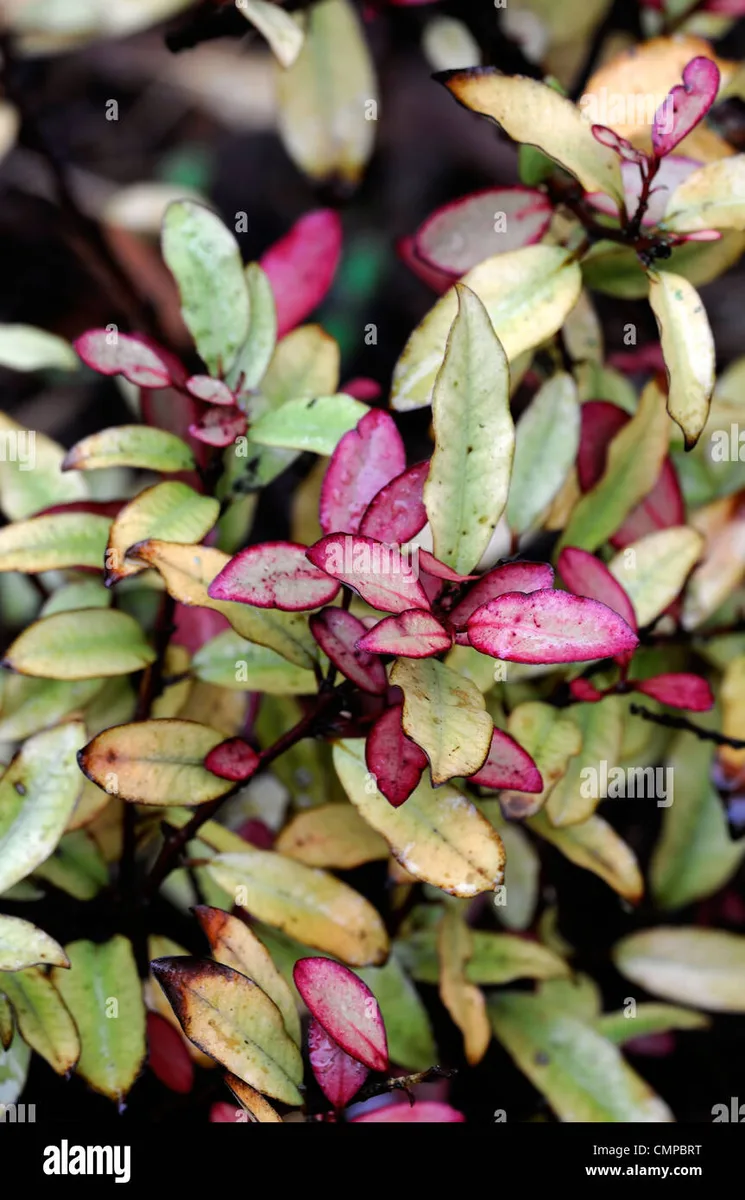
A slow-growing, compact evergreen shrub to 1m tall, with dark red stems bearing leathery leaves; the new growth is golden yellow with a pink tinge and older foliage is pale green. All leaves bear a red margin. In late spring clusters of cup-shaped, greenish-yellow flowers are produced; these are followed by small red berries that ripen to black
Scientific classification
- Species
- Pseudowintera colorata 'Marjorie Congreve' (Pseudowintera colorata 'Marjorie Congreve')
- Genus
- Pseudowintera
- Family
- Winteraceae
- Order
- Canellales
- Class
- Magnoliopsida
- Phylum
- Magnoliophyta
- Information to be completed
- Toxicity
- Shrubs
- Plant type
- 0.5-1 metres
- Height
- 0.5-1 metres
- Spread
- Evergreen
- Foliage
- Bushy
- Habit
- Autumn · Spring · Summer · Winter
- Season of interest
- Full sun · Partial shade
- Sunlight
- Information to be completed
- Ideal temperature









Pseudowintera colorata 'Marjorie Congreve' pictures
Distribution of Pseudowintera colorata 'Marjorie Congreve'
Distribution map
- Native
- Introduced
- Cultivated
Source:WCVP v16 · Royal Botanic Gardens, Kew · CC BY 3.0 · Boundaries:WGSRPD / TDWG
Pseudowintera colorata 'Marjorie Congreve' care guide
- Deep moderate irrigation intervals, partial soil dryness allowed between rounds
- Watering
- Full sun · Partial shade
- Sunlight

Watering
Deep moderate irrigation intervals, partial soil dryness allowed between rounds
Fertilizing
 Fertilizing
Balanced small shrub feed twice annually spring and mid-summer time
Pruning
 Pruning
Usually little pruning is needed. Lightly shape if necessary, removing dead, damaged or diseased shoots. Prune after flowering.
Propagation
 Propagation
Propagate by seed. Root semi-ripe cuttings with bottom heat in summer
Growing
 Growing
Grow in humus-rich, neutral to acid, moist but well-drained soil in full sun or partial shade. Shelter from cold, drying winds
Common pests and diseases
Diseases
Generally disease-free
Pests
Generally pest-free
Explore the plant health library →




