
gerbera [Everlast Carmine]
Also known as: Information to be completed
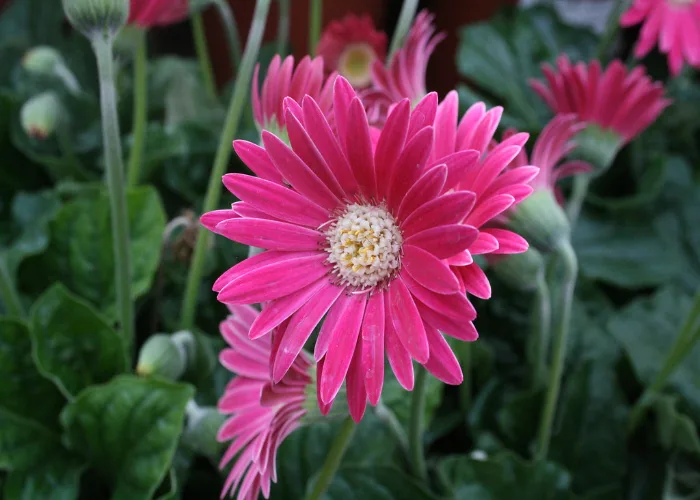
A compact, semi-evergreen perennial to around 35cm tall and wide with dark green, lobed leaves forming a basal rosette. Daisy-like flowers comprising magenta-pink ray florets surrounding a pale eye are borne over a long season
Scientific classification
- Species
- gerbera [Everlast Carmine] (Gerbera Everlast Carmine ('Amgerbcar'))
- Genus
- Gerbera
- Family
- Asteraceae
- Order
- Asterales
- Class
- Magnoliopsida
- Phylum
- Tracheophyta
- Information to be completed
- Toxicity
- Herbaceous Perennial · Bedding · Conservatory Greenhouse
- Plant type
- 0.1-0.5 metres
- Height
- 0.1-0.5 metres
- Spread
- Semi evergreen
- Foliage
- Bushy
- Habit
- Spring · Summer · Autumn · Winter
- Season of interest
- Full sun
- Sunlight
- Information to be completed
- Ideal temperature









gerbera [Everlast Carmine] pictures
gerbera [Everlast Carmine] care guide
- Even moist potting mix, drain standing water from pot bottom tray
- Watering
- Full sun
- Sunlight

Watering
Even moist potting mix, drain standing water from pot bottom tray
Fertilizing
 Fertilizing
Weak gerbera liquid feed monthly during spring and summer months
Pruning
 Pruning
Deadhead spent flowers
Propagation
 Propagation
Propagate for home use by division in early spring or by basal cuttings, or heel cuttings from side shoots, in summer
Growing
 Growing
Grow in fertile well-drained soil in a sheltered position in full sun; ideal for patio containers grown in a loam-based potting compost (JI No.2) and may be overwintered under glass in colder areas. See Gerbera cultivation for further information
Common pests and diseases
Diseases
In low winter temperatures, plants may be susceptible to powdery mildews and grey moulds; may be affected by a leaf spot or root rot
Pests
May be susceptible to aphids, leaf miners and glasshouse whitefly
Explore the plant health library →




