
red star 'Tetra Red'
Also known as: Information to be completed
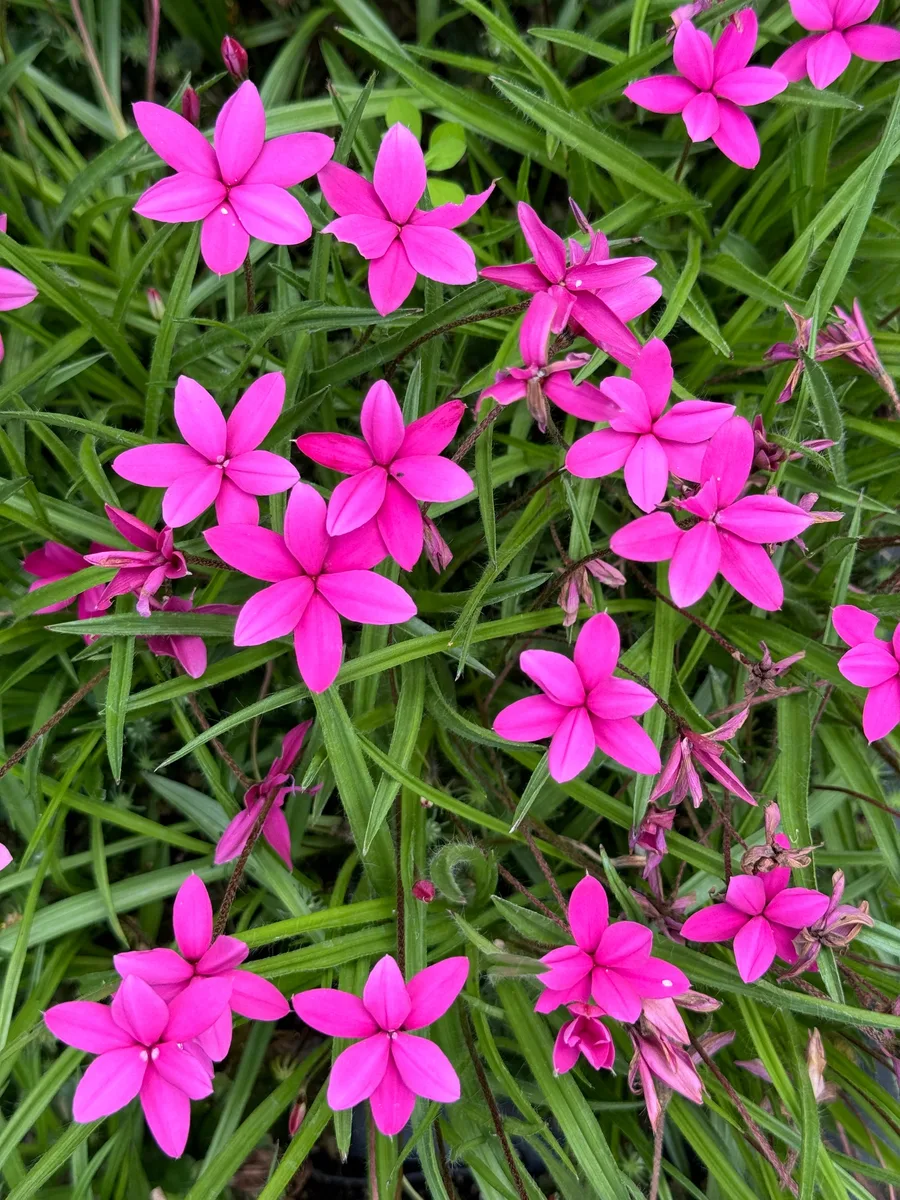
Tetra Red' is a clump-forming alpine herbaceous perennial 10cm high with basal clusters of keeled, folded, dull greyish green leaves, to 10cm long, and large deep cerise-pink, almost red, flowers with broad tepals throughout summer
Scientific classification
- Species
- red star 'Tetra Red' (Rhodohypoxis baurii 'Tetra Red')
- Genus
- Rhodohypoxis
- Family
- Hypoxidaceae
- Order
- Asparagales
- Class
- Liliopsida
- Phylum
- Magnoliophyta
- Information to be completed
- Toxicity
- Alpine Rockery
- Plant type
- Up to 10 cm
- Height
- 0-0.1 metre
- Spread
- Deciduous
- Foliage
- Clump forming
- Habit
- Spring · Summer · Autumn
- Season of interest
- Full sun
- Sunlight
- Information to be completed
- Ideal temperature









red star 'Tetra Red' pictures
Distribution of red star 'Tetra Red'
Distribution map
- Native
- Introduced
- Cultivated
Source:WCVP v16 · Royal Botanic Gardens, Kew · CC BY 3.0 · Boundaries:WGSRPD / TDWG
red star 'Tetra Red' care guide
- Water deeply once substrate surface fully dries out completely
- Watering
- Full sun
- Sunlight

Watering
Water deeply once substrate surface fully dries out completely
Fertilizing
 Fertilizing
Low-strength balanced feed monthly during active growing season
Pruning
 Pruning
No pruning required
Propagation
 Propagation
Propagate by division of established clumps, or by separating offsets, in late autumn
Growing
 Growing
Grow in an alpine house in a mix of equal parts lime-free potting compost, leaf mould, and sharp sand, in full light, water freely and apply a balanced liquid fertilizer monthly when in growth, and keep just moist in winter; or grow outdoors in a trough or rock garden, in well-drained, moderately fertile, humus-rich soil in full sun, and in winter protect with a propped pane of glass to keep plants almost dry
Common pests and diseases
Diseases
Generally disease-free
Pests
May be affected by glasshouse red spider mite and thrips under glass
Explore the plant health library →




