
perennial phlox 'David's Lavender'
Also known as: Information to be completed
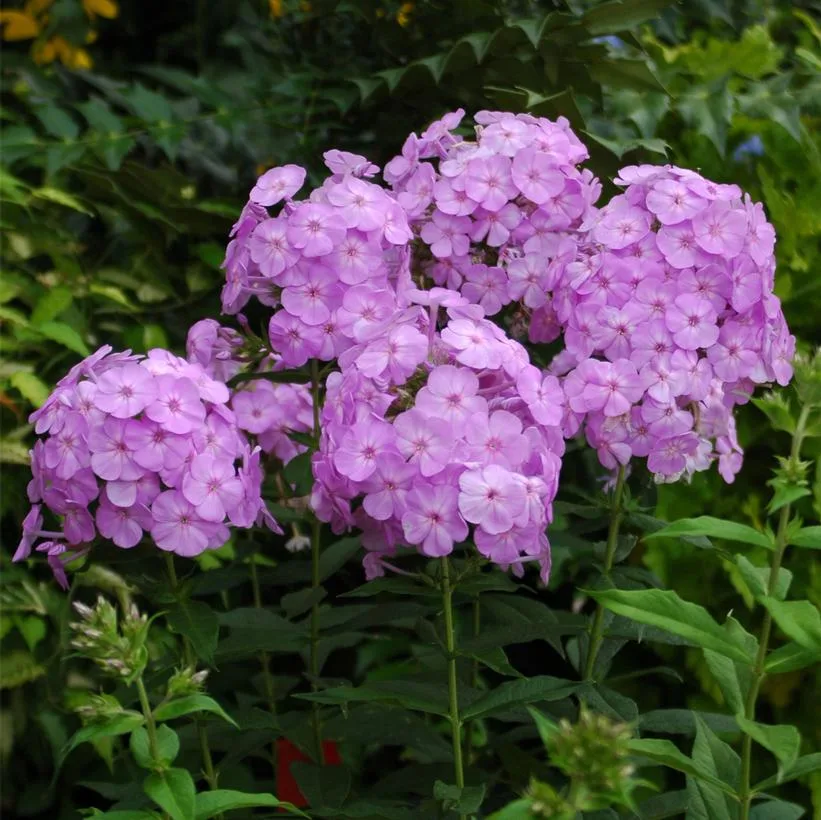
An upright clump forming herbaceous perennial that forms a bushy mound of attractive dark green foliage of narrow, opposite, eliptic leaves and large clusters of tall stemmed fragrant lavender-mauve flowers in mid summer. It has good resistance to powdery mildew.
Scientific classification
- Species
- perennial phlox 'David's Lavender' (Phlox paniculata 'David's Lavender')
- Genus
- Phlox
- Family
- Polemoniaceae
- Order
- Ericales
- Class
- Magnoliopsida
- Phylum
- Magnoliophyta
- Information to be completed
- Toxicity
- Herbaceous Perennial
- Plant type
- 1-1.5 metres
- Height
- 0.5-1 metres
- Spread
- Deciduous
- Foliage
- Columnar upright
- Habit
- Spring · Summer · Autumn
- Season of interest
- Full sun · Partial shade
- Sunlight
- Information to be completed
- Ideal temperature









perennial phlox 'David's Lavender' pictures
Distribution of perennial phlox 'David's Lavender'
Distribution map
- Native
- Introduced
- Cultivated
Source:WCVP v16 · Royal Botanic Gardens, Kew · CC BY 3.0 · Boundaries:WGSRPD / TDWG
perennial phlox 'David's Lavender' care guide
- Moderate regular watering, allowing brief slight drying between soakings
- Watering
- Full sun · Partial shade
- Sunlight

Watering
Moderate regular watering, allowing brief slight drying between soakings
Fertilizing
 Fertilizing
Balanced perennial feed every four weeks from spring through summer
Pruning
 Pruning
Deadhead to promote continous flowering and cut back to the base in late autumn or early winter
Propagation
 Propagation
Propagate by division in autumn or spring, by basal cuttings in spring, or by a root cutting in early autumn or winter
Growing
 Growing
Will grow well in fertile moist but well-drained soil in full sun or partial shade. Apply fertilizer in Spring to promote growth or a thin layer of compost top dressing to add nutrients to the soil. Pinch back growing tips to promote bushiness.
Common pests and diseases
Diseases
May be susceptible to Powdery mildews, grey moulds and leafy gall
Pests
May be susceptible to stem and bulb eelworm
Explore the plant health library →




