
Himalayan honeysuckle 'Gold Leaf'
Also known as: Information to be completed
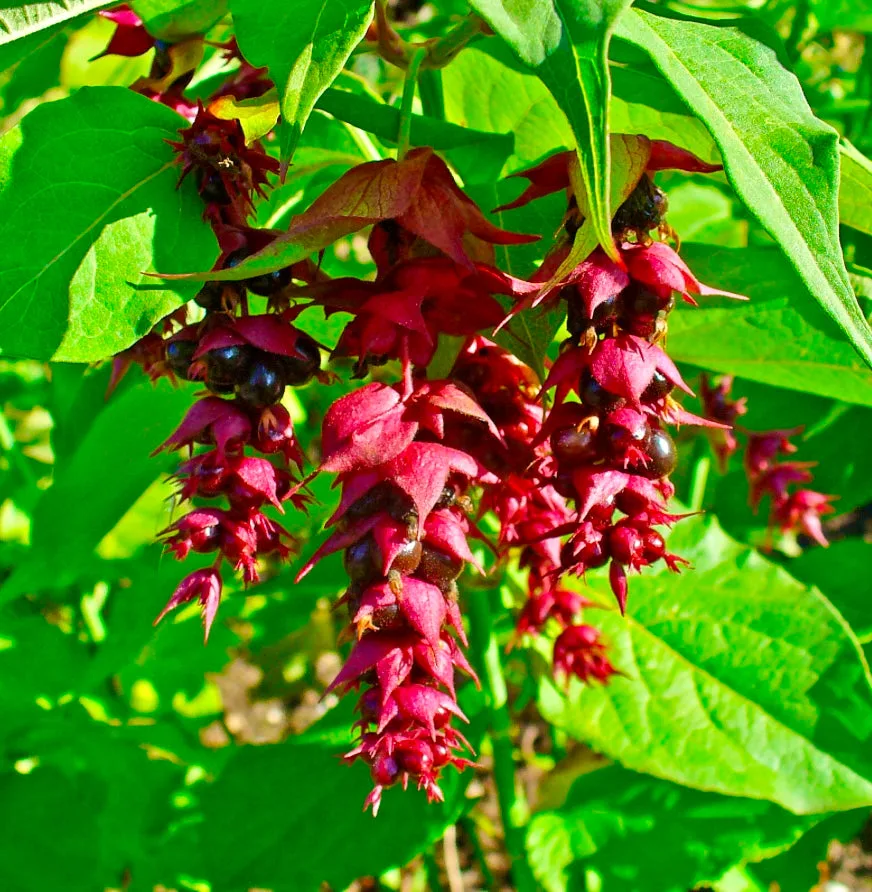
A deciduous shrub to 1.8m high, forming a thicket of upright, cane-like stems bearing bright yellow-green tapered leaves that are flushed with reddish pink. Pendent clusters of white flowers with showy dark red bracts are produced in summer, followed by purple-brown berries in autumn
Scientific classification
- Species
- Himalayan honeysuckle 'Gold Leaf' (Leycesteria formosa 'Gold Leaf')
- Genus
- Leycesteria
- Family
- Caprifoliaceae
- Order
- Dipsacales
- Class
- Magnoliopsida
- Phylum
- Tracheophyta
- Fruit are ornamental - not to be eaten. Wear gloves and other protective equipment when handling
- Toxicity
- Shrubs
- Plant type
- 1.5-2.5 metres
- Height
- 1.5-2.5 metres
- Spread
- Deciduous
- Foliage
- Columnar upright · Bushy
- Habit
- Spring · Summer · Autumn
- Season of interest
- Full sun · Partial shade
- Sunlight
- Information to be completed
- Ideal temperature









Himalayan honeysuckle 'Gold Leaf' pictures
Distribution of Himalayan honeysuckle 'Gold Leaf'
Distribution map
- Native
- Introduced
- Cultivated
Source:WCVP v16 · Royal Botanic Gardens, Kew · CC BY 3.0 · Boundaries:WGSRPD / TDWG
Toxicity
Fruit are ornamental - not to be eaten. Wear gloves and other protective equipment when handling
Himalayan honeysuckle 'Gold Leaf' care guide
- Moderate regular watering, allowing brief slight drying between soakings
- Watering
- Full sun · Partial shade
- Sunlight

Watering
Moderate regular watering, allowing brief slight drying between soakings
Fertilizing
 Fertilizing
Balanced perennial feed every four weeks from spring through summer
Pruning
 Pruning
Shorten flowered shoots to vigorous sideshoots; remove about a third of stems at ground level annually. Prune immediately after flowering.
Propagation
 Propagation
Propagate by seed or softwood cuttings
Growing
 Growing
Grow in moderately fertile, well-drained soil in full sun or light shade. Heavy, wet soils are best avoided. In areas prone to hard frosts, will benefit from a deep mulch in autumn
Common pests and diseases
Diseases
May be susceptible to honey fungus (rarely)
Pests
Generally pest-free
Explore the plant health library →




