
Linaria triornithophora 'Rosea'
Also known as: Information to be completed
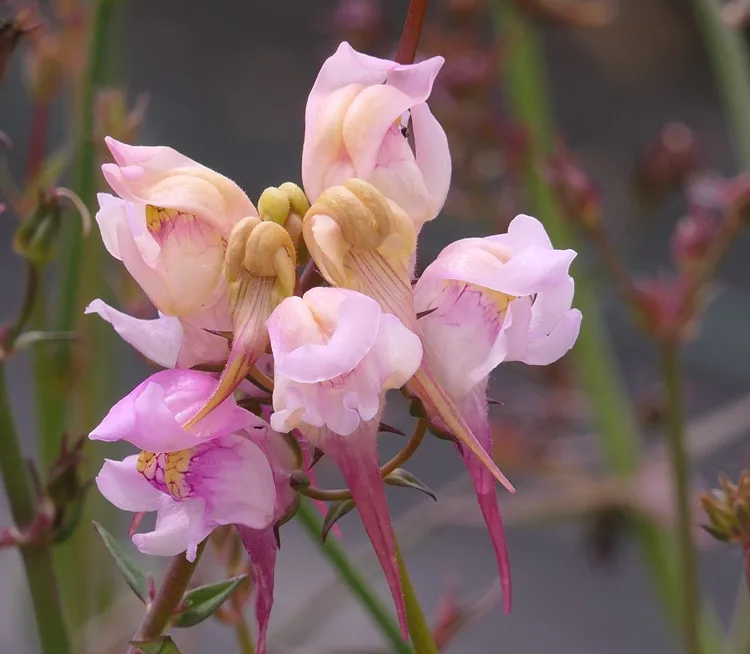
An herbaceous perennial grown as an annual to 90cm, flowering in its first year from seed. It has whorls of fine, narrow, grey-green leaves topped from mid-summer to autumn with shorts spikes of small, snapdragon-like pink flowers with yellow centres which resemble budgerigars
Scientific classification
- Species
- Linaria triornithophora 'Rosea' (Linaria triornithophora 'Rosea')
- Genus
- Linaria
- Family
- Plantaginaceae
- Order
- Lamiales
- Class
- Magnoliopsida
- Phylum
- Magnoliophyta
- Information to be completed
- Toxicity
- Herbaceous Perennial
- Plant type
- 0.5-1 metres
- Height
- 0.5-1 metres
- Spread
- Deciduous
- Foliage
- Bushy
- Habit
- Spring · Summer · Autumn
- Season of interest
- Full sun
- Sunlight
- Information to be completed
- Ideal temperature









Linaria triornithophora 'Rosea' pictures
Distribution of Linaria triornithophora 'Rosea'
Distribution map
- Native
- Introduced
- Cultivated
Source:WCVP v16 · Royal Botanic Gardens, Kew · CC BY 3.0 · Boundaries:WGSRPD / TDWG
Linaria triornithophora 'Rosea' care guide
- Frequent light watering, substrate stays slightly damp always
- Watering
- Full sun
- Sunlight

Watering
Frequent light watering, substrate stays slightly damp always
Fertilizing
 Fertilizing
Weak toadflax blooming feed weekly entire warm growing cycle
Pruning
 Pruning
After flowering, plants can be cut back to prevent self-seeding
Propagation
 Propagation
Propagate by seed in pots in a cold frame in early spring. Propagate by division or softwood cuttings in spring
Growing
 Growing
Grow in moderately fertile, light, well-drained soil in full sun
Common pests and diseases
Diseases
May be susceptible to powdery mildews
Pests
May be susceptible to aphids
Explore the plant health library →




