
commonName:"astilbe 'Beauty of Ernst'"
Also known as: Information to be completed
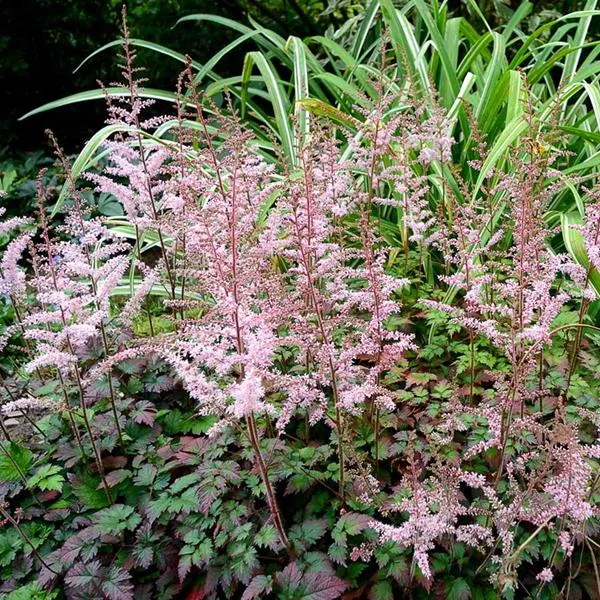
A clump-forming perennial to 60cm, with divided, fern-like foliage opening bright green in spring, gradually turning red-purple and green in summer, and developing gold, orange and russet tints in autumn. Long, narrow, feathery plumes of pale pink flowers on dark red stems appear from mid- to late summer
Scientific classification
- Species
- commonName:"astilbe 'Beauty of Ernst'" (Astilbe 'Beauty of Ernst')
- Genus
- Astilbe
- Family
- Saxifragaceae
- Order
- Saxifragales
- Class
- Magnoliopsida
- Phylum
- Magnoliophyta
- Information to be completed
- Toxicity
- Bogs · Herbaceous Perennial
- Plant type
- 0.5-1 metres
- Height
- 0.5-1 metres
- Spread
- Deciduous
- Foliage
- Clump forming
- Habit
- Autumn · Spring · Summer
- Season of interest
- Partial shade
- Sunlight
- Information to be completed
- Ideal temperature









commonName:"astilbe 'Beauty of Ernst'" pictures
commonName:"astilbe 'Beauty of Ernst'" care guide
- Keep soil consistently moist, especially during dry weather; do not let it dry out.
- Watering
- Partial shade
- Sunlight

Watering
Keep soil consistently moist, especially during dry weather; do not let it dry out.
Fertilizing
 Fertilizing
Apply a balanced fertilizer monthly during the growing season.
Pruning
 Pruning
Flowering stems may be cut back when flowers fade, or left standing for winter interest
Propagation
 Propagation
Propagate by division in winter or early spring; replant immediately or pot up to plant out in spring when re-established
Growing
 Growing
Grow in moist but well-drained or boggy soil in dappled shade, or in indirect sun where the soil remains moisture-retentive in summer. Drought intolerant, may be damaged in hot sun. Good for waterside planting. See Astilbe cultivation
Common pests and diseases
Diseases
May be susceptible to leaf spot and Powdery mildews
Pests
May be susceptible to vine weevil
Explore the plant health library →




