
Japanese maple 'Ryusen'
Also known as: Information to be completed
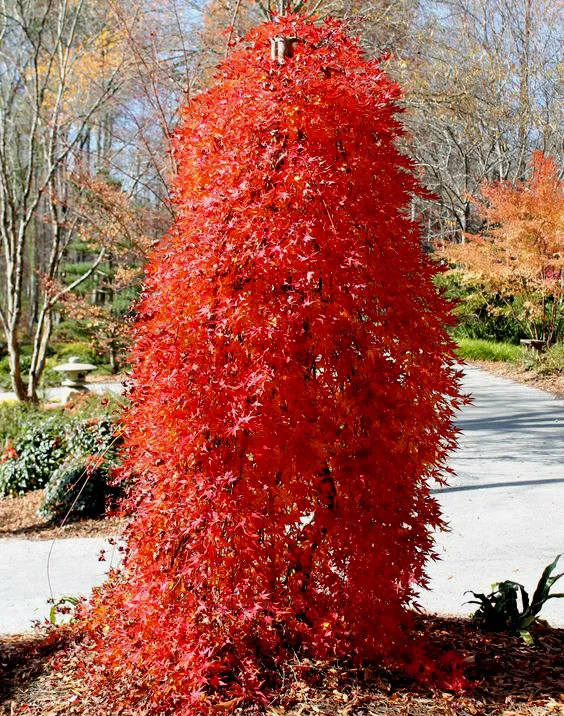
A small, slow-growing, weeping tree that can ultimately reach 2m tall and 1m across, with vertically hanging branches. The leaves are five-lobed, bright green, turning red, yellow and orange in autumn. Inconspicuous green flowers in spring are followed by red, winged fruit in autumn
Scientific classification
- Species
- Japanese maple 'Ryusen' (Acer palmatum 'Ryusen')
- Genus
- Acer
- Family
- Sapindaceae
- Order
- Sapindales
- Class
- Magnoliopsida
- Phylum
- Magnoliophyta
- Information to be completed
- Toxicity
- Trees
- Plant type
- 1.5-2.5 metres
- Height
- 1-1.5 metres
- Spread
- Deciduous
- Foliage
- Pendulous weeping
- Habit
- Autumn · Spring · Summer
- Season of interest
- Partial shade
- Sunlight
- Information to be completed
- Ideal temperature









Japanese maple 'Ryusen' pictures
Japanese maple 'Ryusen' care guide
- Moderate regular watering, prevent full drying of shallow root system
- Watering
- Partial shade
- Sunlight

Watering
Moderate regular watering, prevent full drying of shallow root system
Fertilizing
 Fertilizing
Maple tree slow-release feed applied once annually early spring period
Pruning
 Pruning
Little pruning is needed. Remove diseased, damaged, crowded or crossing shoots and unwanted growth. Timing depends on the plant: generally late winter or early spring; plants prone to bleeding and deciduous magnolias need different timing, and deciduous azaleas and lilacs are pruned after flowering.
Propagation
 Propagation
Propagate by semi-hardwood cuttings or by layering
Growing
 Growing
Grows best in slightly acidic, humus-rich, well-drained soil, but tolerates most soils if improved with well-rotted organic matter. Hot, dry air, cold wind and late frost may cause leaf scorching. Mulch in autumn to protect shallow roots from cold and drying out. See Japanese maple cultivation
Common pests and diseases
Diseases
May be susceptible to Verticillium wilt, Acer leaf scorch and honey fungus
Pests
May be susceptible to Acer gall mite, aphids, caterpillars and horse chestnut scale
Explore the plant health library →




