
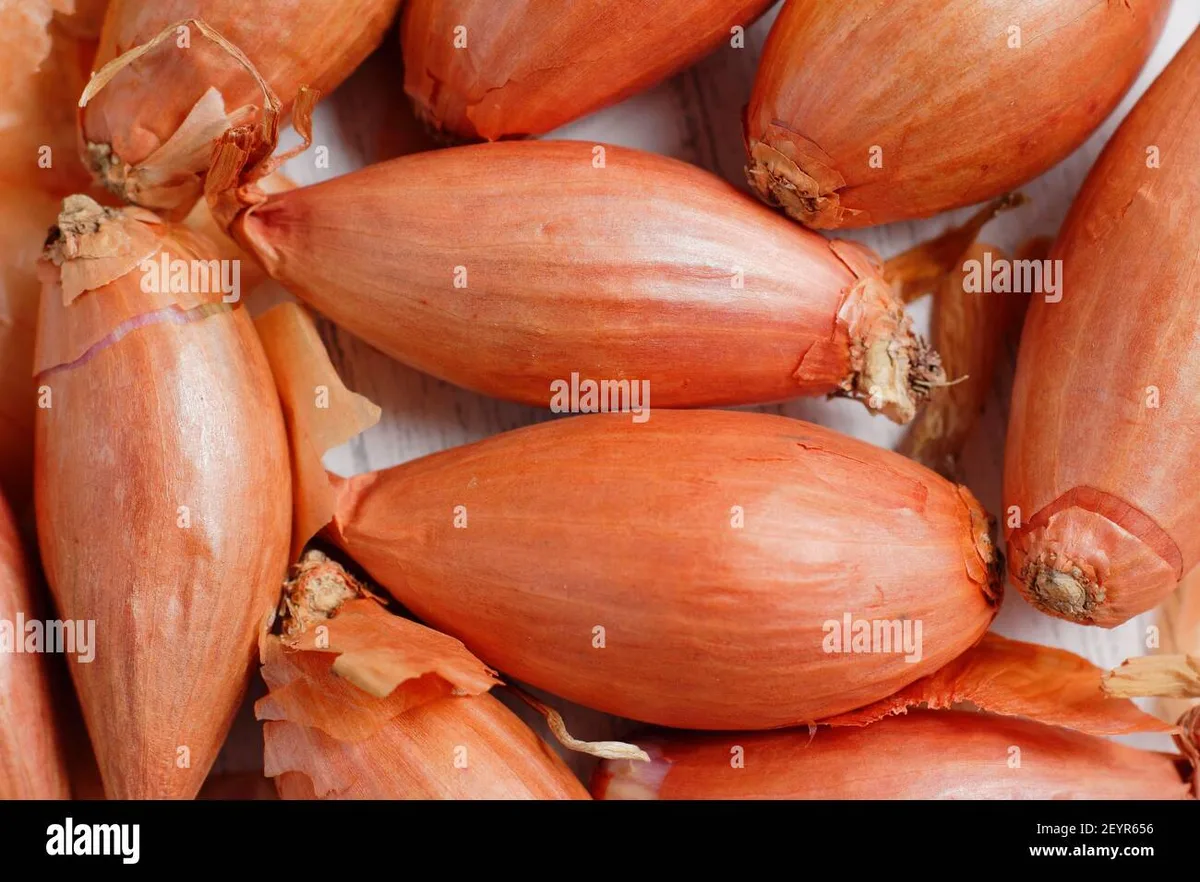
shallot 'Banana'
Also known as: Information to be completed
A larger, elongated shallot with light brown skin with good flavour. Often referred to as ‘banana’ type or echalion
Scientific classification
- Species
- shallot 'Banana' (Allium cepa 'Banana')
- Genus
- Allium
- Family
- Amaryllidaceae
- Order
- Asparagales
- Class
- Liliopsida
- Phylum
- Magnoliophyta
- Information to be completed
- Toxicity
- Herbs - Culinary · Bulbs
- Plant type
- 0.1-0.5 metres
- Height
- 0.1-0.5 metres
- Spread
- Deciduous
- Foliage
- Clump forming
- Habit
- Autumn · Spring · Summer
- Season of interest
- Full sun
- Sunlight
- Information to be completed
- Ideal temperature









shallot 'Banana' pictures
Distribution of shallot 'Banana'
Distribution map
- Native
- Introduced
- Cultivated
Source:WCVP v16 · Royal Botanic Gardens, Kew · CC BY 3.0 · Boundaries:WGSRPD / TDWG
shallot 'Banana' care guide
- Moist soil during active growth, then reduce watering after foliage yellows
- Watering
- Full sun
- Sunlight

Watering
Moist soil during active growth, then reduce watering after foliage yellows
Fertilizing
 Fertilizing
Light bulb fertilizer at emergence and again after flowering
Pruning
 Pruning
Not required
Propagation
 Propagation
Propagate by seed. See sowing vegetable seeds
Growing
 Growing
Grow in fertile, moisture retentive, but well-drained soil in full sun. Consider liming if the soil is acid, pH below 6.5. See How to grow: shallots for further advice
Common pests and diseases
Diseases
May be susceptible to onion white rot, onion downy mildew, leek rust and onion neck rot. Bolting, producing flowers, may be a problem
Pests
May be susceptible to onion fly and narcissus eelworm
Explore the plant health library →




