
taro 'Pink China'
Also known as: Information to be completed
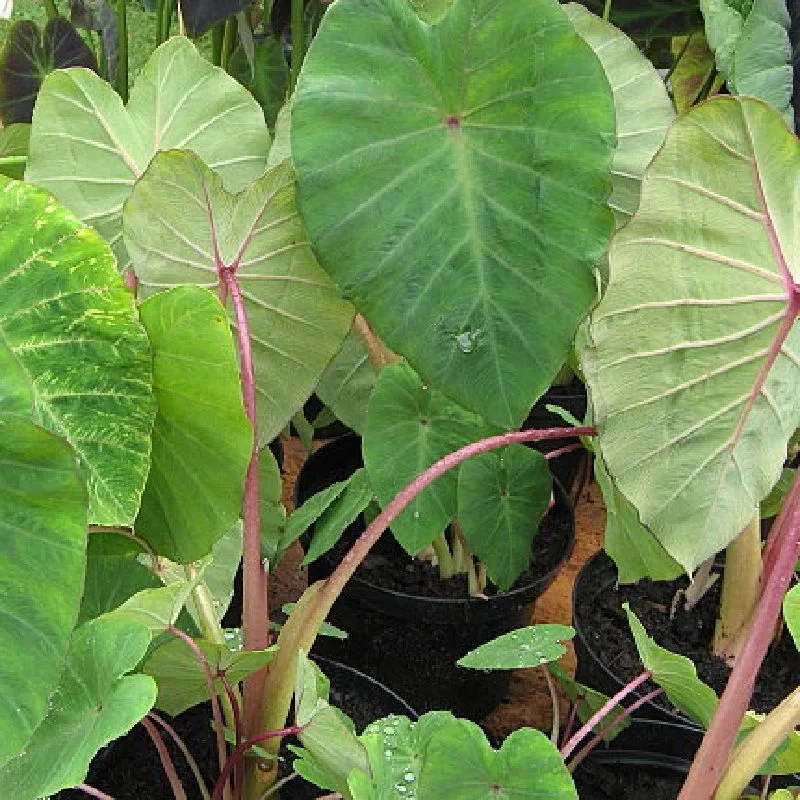
A vigorous, tuberous perennial, 1.2m tall, bearing large, heart-shaped leaves to 60cm. The foliage is light green, held on upright, pink-flushed stalks. A striking summer foliage plant and one of the hardiest colocasias; it will die back after the first frosts but should survive the winter given a deep, dry mulch. However, in very cold areas it is better to lift the rhizome in autumn and store it over winter
Scientific classification
- Species
- taro 'Pink China' (Colocasia esculenta 'Pink China')
- Genus
- Colocasia
- Family
- Araceae
- Order
- Alismatales
- Class
- Liliopsida
- Phylum
- Tracheophyta
- Harmful if eaten, skin/eye irritant. Wear gloves and other protective equipment when handling]
- Toxicity
- Conservatory Greenhouse · Herbaceous Perennial
- Plant type
- 1-1.5 metres
- Height
- 0.5-1 metres
- Spread
- Deciduous
- Foliage
- Clump forming · Columnar upright
- Habit
- Spring · Summer · Autumn
- Season of interest
- Full sun · Partial shade
- Sunlight
- Information to be completed
- Ideal temperature









taro 'Pink China' pictures
Distribution of taro 'Pink China'
Distribution map
- Native
- Introduced
- Cultivated
Source:WCVP v16 · Royal Botanic Gardens, Kew · CC BY 3.0 · Boundaries:WGSRPD / TDWG
Toxicity
Harmful if eaten, skin/eye irritant. Wear gloves and other protective equipment when handling]
taro 'Pink China' care guide
- Keep soil evenly damp all growing season, mist foliage often
- Watering
- Full sun · Partial shade
- Sunlight

Watering
Keep soil evenly damp all growing season, mist foliage often
Fertilizing
 Fertilizing
Tropical tuber feed every three weeks spring to mid-autumn
Pruning
 Pruning
No pruning required
Propagation
 Propagation
Propagate by division of rhizomes
Growing
 Growing
Plant tubers in humus-rich, moist but well-drained soil spring, choosing a sunny or lightly shaded spot with shelter from strong winds. Water freely when the plant comes into growth and apply a high nitrogen feed weekly. Once the foliage dies back in autumn, either cover the crown with a deep, dry mulch, or lift the tuber and store it dry over winter
Common pests and diseases
Diseases
Generally disease-free
Pests
May be susceptible to glasshouse red spider mite, aphids and glasshouse whitefly
Explore the plant health library →




